UM serviço de fundição a vácuo helps you produce detailed prototype parts and small batches without investing in expensive injection molding tools. When you need to validate a product design, test assembly fit, or prepare samples for customer evaluation, conventional tooling may require more time and upfront investment than your project allows. Vacuum casting offers a practical alternative by using silicone molds to reproduce a master model in polyurethane casting resin.
TECNOLOGIA DE PRECISÃO VOK Co., LTD provides rapid prototyping, usinagem de precisão, and low-volume production services for product developers worldwide. Com mais 1,000 clientes globais e dezenas de milhares de projetos concluídos, VOK supports engineers and purchasing teams seeking a suitable manufacturing process for their designs. Understanding the process, opções de materiais, and production limitations helps you decide whether vacuum casting fits your project requirements.
What Is a Vacuum Casting Service?
Vacuum casting is a manufacturing process that uses a master model and a silicone mold to create replica parts. Manufacturers pour liquid casting resin into the mold under vacuum conditions to reduce trapped air and improve the reproduction of fine details.
This process works well for product development when you need multiple parts with consistent shapes, surface details, and dimensions. Depending on the selected resin, you can also produce prototypes that simulate the appearance or selected properties of production plastics.
Aplicações comuns incluem:
- Product design validation: Verifique as dimensões, ajuste de montagem, and overall appearance before committing to production tooling.
- Functional prototype testing: Evaluate parts under defined operating conditions using an appropriate casting resin.
- Presentation samples: Prepare product samples for design reviews, customer demonstrations, or marketing evaluations.
- Produção de baixo volume: Manufacture limited quantities when full-scale injection molding is not yet economically justified.
Como funciona o processo de fundição a vácuo?
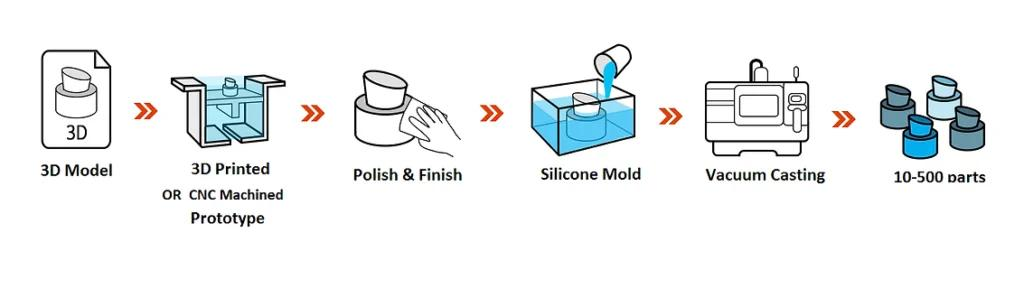
A reliable vacuum casting workflow starts with an accurate master model and continues through mold preparation, fundição, curing, e acabamento. Each stage affects the final part quality.
Etapa 1: Crie o modelo mestre
The master model defines the geometry and surface finish of the final casting. You can use 3D printing or CNC machining to create it, depending on the required detail, precisão dimensional, and surface quality.
Before proceeding, confirm critical dimensions and inspect the model for defects that could transfer to the silicone mold.
Etapa 2: Prepare o molde de silicone
The manufacturer uses the master model to create a silicone mold. Once the silicone cures, the mold is opened or cut to remove the master, leaving a cavity that reproduces its shape.
Mold design, parting lines, undercuts, and the selected demolding method all influence the quality of the finished component.
Etapa 3: Execute fundição a vácuo
The operator prepares the selected resin according to its processing requirements and pours it into the mold under vacuum conditions. Proper material mixing, degassing, mold filling, and temperature control help reduce air bubbles and incomplete filling.
The resin then cures for the specified time. Material selection and curing conditions should match your part geometry and intended application.
Etapa 4: Demold and Finish the Parts
Depois de curar, the operator removes the casting from the silicone mold. Additional work may include trimming excess material, removing gates, sanding surfaces, or applying a suitable finish.
Finally, inspect critical dimensions and visible surfaces against your project specifications before approving the parts.
Key Benefits of Vacuum Casting for Prototypes
A custom vacuum casting service for prototypes can help you balance development speed, tooling cost, and part quality.
- Lower initial tooling costs: Silicone molds generally require less upfront investment than production injection molds, making them suitable for short runs.
- Detailed reproduction: A properly prepared mold can reproduce intricate geometry and surface details from the master model.
- Flexible material selection: Polyurethane casting resins can simulate selected characteristics of plastics such as ABS, PC, PP, and rubber-like materials. Actual properties depend on the specific resin.
- Shorter preparation time: Silicone molds can often be prepared within days, although complexity, projeto de molde, and project requirements affect lead time.
- Support for design iterations: You can evaluate a physical part, identify design issues, and refine the next version before investing in production tooling.
Fundição a vácuo vs.. Moldagem por injeção
Both processes produce plastic components, but they address different production needs. The right option depends on your order quantity, orçamento, requisitos de materiais, e cronograma de entrega.
| Comparison | Fundição a Vácuo | Moldagem por injeção |
|---|---|---|
| Ferramentas | Silicone molds | Production molds, often metal |
| Initial investment | Geralmente mais baixo | Geralmente mais alto |
| Typical production need | Protótipos e pequenos lotes | Médio- to high-volume production |
| Opções de materiais | Selected casting resins | Compatible injection-molding thermoplastics |
| Mudanças de design | New silicone molds may be needed | Mold modifications may be costly |
| Unit cost at scale | Often higher | Can decrease with larger volumes |
Vacuum casting is worth considering when you need a limited quantity of parts before confirming the final design. Injection molding may become more economical when demand increases and the design is stable.
Vacuum Casting Overmolding Solutions
Vacuum casting overmolding combines two or more materials or components within a multi-stage process. Depending on the design and material compatibility, this approach can create parts that combine rigid sections with flexible surfaces or integrate metal inserts into a cast component.
VOK offers overmolding options that include:
- Rigid plastic over rubber-like material
- Metal inserts with rigid casting resin
- Metal inserts with rubber-like casting material
- Insert overmolding for integrated components
These solutions may suit product housings, grips, interface components, and other designs that require different material characteristics in one assembly. Confirm material compatibility, bonding requirements, and dimensional tolerances before selecting an overmolding method.
Why Work with VOK Precision Technology?
TECNOLOGIA DE PRECISÃO VOK Co., LTDA provides a range of manufacturing services, incluindo usinagem CNC e torneamento, SLA/SLS/FDM 3D printing, fabricação de chapas metálicas, fundição a vácuo, ferramentas rápidas, e moldagem por injeção.
The company reports more than 1,000 clientes globais e dezenas de milhares de projetos concluídos, with experience serving customers across Europe, América do Norte, e Ásia-Pacífico. Its services support product development in automotive, médico, aeroespacial, eletrônica, e aplicações de automação.
When requesting a quote, provide your 3D files, quantidade necessária, target material properties, acabamento superficial, critical dimensions, e expectativas de entrega. These details help the manufacturing team assess feasibility and recommend a suitable process. For tight-tolerance or regulated applications, request the applicable inspection records and material documentation rather than assuming every casting meets the same requirements.
Frequently Asked Questions
1. How many parts can a vacuum casting service produce?
Vacuum casting is commonly used for prototypes and small production batches. The practical quantity depends on part size, mold durability, geometria, e requisitos de qualidade. Share your target quantity with the manufacturer to evaluate the most suitable process.
2. Which materials are available for vacuum casting?
Manufacturers commonly use polyurethane casting resins that simulate selected properties of ABS, PC, PP, and flexible rubber-like materials. Availability and performance vary by resin, so confirm hardness, força, temperature resistance, and other required properties before ordering.
3. Is vacuum casting suitable for functional prototypes?
Sim, when the selected resin and manufacturing process meet your testing requirements. No entanto, a prototype resin may not reproduce every property of the final production material. Define the intended test conditions before selecting a material.
Conclusão
UM serviço de fundição a vácuo offers a practical route from master model to detailed prototypes and low-volume parts, particularly when you need to control initial tooling costs and evaluate a design before mass production. By reviewing material properties, projeto de molde, requisitos dimensionais, and production quantities, you can choose a process that fits your development goals. TECNOLOGIA DE PRECISÃO VOK Co., LTDA combines vacuum casting with CNC machining, 3Impressão D, and other manufacturing capabilities to support different stages of product development.
Request a Vacuum Casting Quote from VOK
Send your 3D drawings, target quantity, preferred material properties, and required delivery date to inquiry@vokmodel.com or call +86 18124139075. Ask the team to review your part geometry, recommend a suitable casting approach, and clarify tooling costs, tempo de espera, and inspection requirements before production.