When a plastic part looks right in a CAD model, can you be sure it will perform as expected in production? Design flaws, material behavior, frais d'outillage, and delayed sample approval can turn a promising project into an expensive redesign. Rapid mold prototyping helps you evaluate plastic part designs, test mold performance, and identify potential manufacturing issues before committing to full-scale production.
Pour les ingénieurs, concepteurs de produits, and procurement teams, the challenge is finding the right balance between development speed, qualité des pièces, et coût de production. VOK PRÉCISION TECHNOLOGIE Co., LTD fournit un prototypage rapide, usinage de précision, outillage rapide, and injection molding services to help you move from design validation toward repeatable manufacturing. Avec plus 1,000 global clients and more than 5,000 projets réalisés chaque année, VOK supports product development across automotive, médical, aérospatial, électronique, et applications d'automatisation.
What Is Rapid Mold Prototyping?
Rapid mold prototyping is a manufacturing approach that uses quickly developed molds and trial molding to evaluate plastic part designs before investing in production tooling. It allows you to assess part geometry, ajustement de l'assemblage, aspect de la surface, and selected functional requirements using molded samples.
Unlike CNC machining or 3D printing, which create parts through material removal or layer-by-layer fabrication, mold-based prototyping produces parts by injecting plastic into a cavity. This makes it particularly useful when you need to understand how a component behaves under actual molding conditions.
When Should You Use Rapid Tooling?
Rapid tooling is worth considering when you need to:
- Validate a plastic housing, enclosure, connector, or mechanical component before mass production.
- Check assembly tolerances and fit with neighboring components.
- Evaluate surface finish, épaisseur de paroi, and potential molding defects.
- Produce bridge quantities while final production tooling is being prepared.
- Reduce the risk of expensive tooling changes after design approval.
The best approach depends on your part geometry, exigences en matière de résine, expected volume, and testing objectives. Discussing these factors early helps you avoid investing in a mold that does not match your production needs.
Rapid Mold Prototyping vs. Moulage par injection
Rapid tooling and production injection molding serve different stages of product development. Rapid tooling prioritizes development speed and design validation, while production tooling focuses on repeatability, cycle efficiency, and long-term manufacturing economics.
| Fonctionnalité | Outillage rapide | Production Injection Molding |
|---|---|---|
| Initial tooling investment | Généralement inférieur | Généralement plus élevé |
| Development lead time | Typically shorter | Usually longer for new production molds |
| Application typique | Production de prototypes et de ponts | Moyen- and high-volume production |
| Design flexibility | Useful for early design changes | Changes may require costly mold modifications |
| Part cost at scale | May be higher per part | Often lower at sufficient volumes |
| Main objective | Validate design and process | Maintain consistent output efficiently |
Actual costs and lead times depend on mold complexity, cavity count, sélection des matériaux, tooling life, et exigences de qualité. For some projects, rapid tooling can also support low-volume manufacturing without immediately requiring a dedicated production mold.
VOK evaluates your projected volume, target schedule, and budget to help you choose an appropriate manufacturing route.
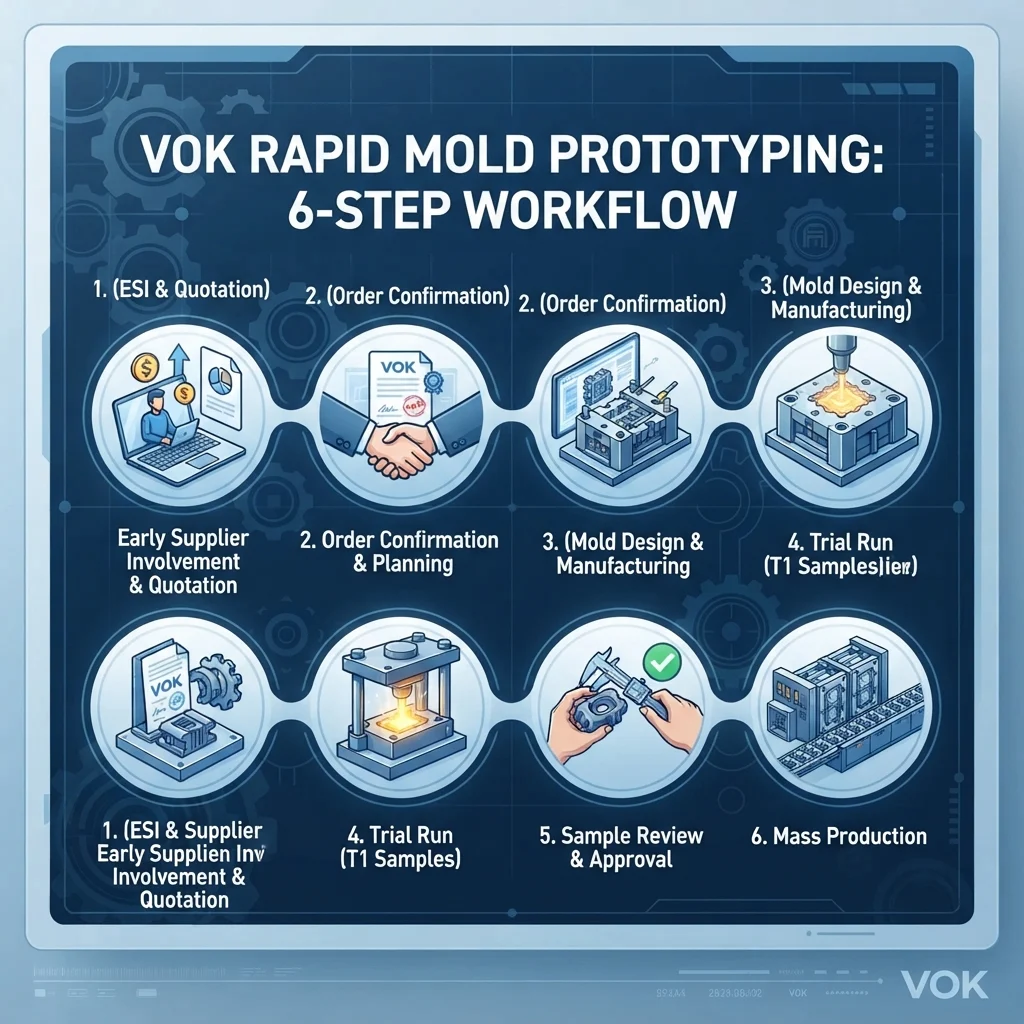
VOK’s 6-Step Injection Molding Process
A structured workflow helps you identify problems early and maintain clear approval points throughout mold development.
- Early Supplier Involvement (ESI) and Quotation: Share your 3D CAD files, dessins, exigences matérielles, and target quantities. VOK reviews the project scope and provides a quotation for evaluation.
- Order Confirmation and Planning: Confirm the project requirements, delivery expectations, and tooling plan. Resolve outstanding design questions before mold manufacturing begins.
- Conception et fabrication de moules: The team develops and manufactures the mold according to the agreed part geometry and production requirements.
- Essai: Produce initial molded samples to evaluate dimensions, apparence, ajuster, and other agreed acceptance criteria.
- Sample Review and Approval: Test the samples against your drawings and functional requirements. Request necessary adjustments and approve the samples before proceeding.
- Production de masse: After sample approval and production readiness checks, move into the agreed production phase with defined quality requirements.
This process gives your engineering team an opportunity to review real molded parts rather than relying entirely on digital models. Early feedback can also help reduce the risk of discovering design or tooling issues after production has started.
Two-Shot Injection Molding and Metal Insert Overmolding
Different products require different molding techniques. VOK’s showcased projects include two-shot injection molding and metal insert overmolding, which address specific component design and integration needs.
Moulage par injection à deux coups
Two-shot injection molding combines two material shots in a single molding process to create a component with distinct materials or colors. Depending on the material combination and mold design, this approach can support integrated product features and reduce the need for separate assembly operations.
It may suit product housings, controls, poignées, and components that require different surface properties. Material compatibility and bonding performance should be assessed during development.
Surmoulage d'insert métallique
Metal insert overmolding incorporates a metal insert into a molded plastic component. It can help combine the structural or fastening properties of metal with the design flexibility of plastic.
Potential applications include threaded fastening points, electrical components, and mechanical assemblies. Insert positioning, plastic flow, compatibilité des matériaux, and dimensional stability should be reviewed during mold trials.
Why Work With VOK for Rapid Tooling?
VOK PRÉCISION TECHNOLOGIE Co., LTD provides multiple manufacturing services under one supplier, y compris l'usinage et le tournage CNC, Impression 3D SLA/SLS/FDM, fabrication de tôle, moulage d'uréthane, outillage rapide, et moulage par injection.
Its company profile lists more than 20 années d'expérience dans l'industrie, sur 200 personnel, un 3,000 m² de base de production, et plus que 5,000 projets par an. VOK also reports serving over 1,000 clients mondiaux.
Pour votre projet, these capabilities can support a more coordinated development process, particularly when plastic components need machined features, complementary metal parts, or prototypes made using different processes.
Before placing an order, confirm the specific resin grades, tolérances dimensionnelles, inspection methods, applicable certifications, and sample acceptance criteria required for your application. These details help establish clear quality expectations and reduce misunderstandings during production.
Foire aux questions
1. How is rapid mold prototyping different from 3D printing?
Rapid mold prototyping uses a mold to form plastic parts, while 3D printing builds parts layer by layer. Molded prototypes are useful for evaluating injection-molded geometry and process behavior; 3D printing can be more convenient for early design iterations without mold fabrication.
2. Is rapid tooling suitable for low-volume production?
Oui. Rapid tooling can support bridge production and some low-volume projects. Suitability depends on the mold material, expected part quantity, résine, géométrie, and required tooling life.
3. What information should you provide for an injection mold quotation?
Prepare your 3D CAD model, 2D drawings, spécification matérielle, estimated order quantity, target delivery date, et exigences de qualité. If available, include assembly details and testing criteria so the supplier can evaluate the project more accurately.
Conclusion
Rapid mold prototyping gives you a practical way to evaluate plastic part designs, assess tooling performance, and prepare for low-volume or mass production. By comparing rapid tooling with production injection molding and defining sample approval criteria early, you can make better-informed decisions about development cost, timing, and manufacturing readiness.
VOK PRÉCISION TECHNOLOGIE Co., LTD combines rapid prototyping, outillage, and injection molding capabilities to support your project from initial design evaluation to production.
Request a Rapid Tooling Review
Envoyer VOK your CAD files, target material, volume de production attendu, and project timeline. The team can review your requirements and help identify a suitable tooling and injection molding strategy for your application.