5 Axis Precision CNC machining helps you manufacture complex components with precise features, angled surfaces, and multiple machining faces. If you are developing a prototype or preparing a new product for production, choosing the right machining process can affect dimensional accuracy, ajustement de l'assemblage, délai de mise en œuvre, and overall cost. Repeated setups can introduce alignment errors, while unsuitable materials or machining strategies can create problems during functional testing.
VOK Precision Technology Co., Ltée. provides CNC machining services for engineers, développeurs de produits, and manufacturers who need custom metal and plastic components. Avec plus de 20 années d'expérience dans l'industrie, over 200 membres du personnel, un 3,000 m² de base de production, et 5,000+ projets par an, VOK supports projects ranging from early-stage prototypes to low-volume and volume production. Its capabilities include five-axis machining, Fraisage CNC, Tournage CNC, and additional manufacturing processes.
What Is 5 Axis Precision CNC Machining?
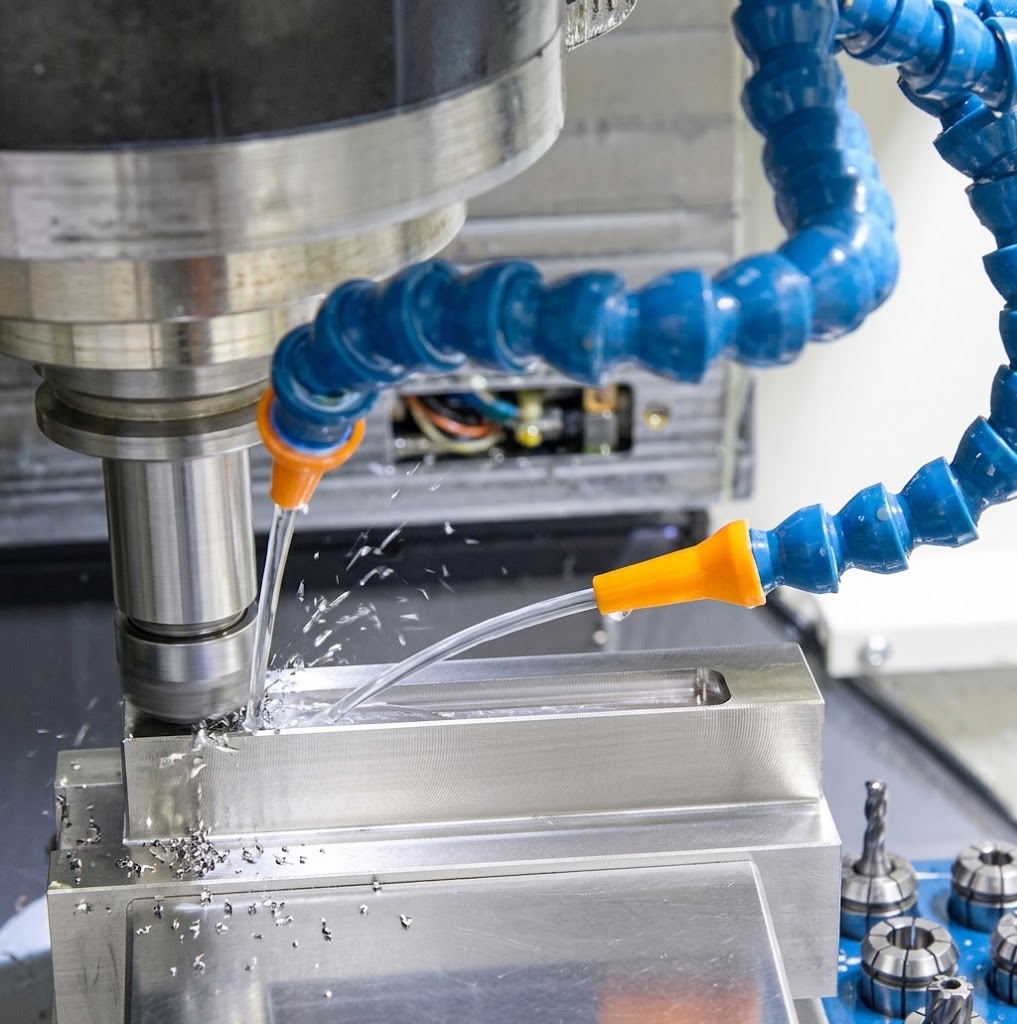
Five-axis CNC machining uses three linear axes (X, Y, and Z) and two rotational axes to position a cutting tool or workpiece from multiple directions. This configuration allows manufacturers to machine complex geometries and multiple surfaces with fewer setups than many conventional three-axis operations.
Pour votre projet, five-axis machining can be useful when a component includes angled holes, curved surfaces, compound angles, or features that are difficult to access using standard milling equipment.
Les applications typiques incluent:
- Pièces automobiles et motos: Custom housings, parenthèses, and functional prototype components.
- Aerospace and aviation components: Complex metal parts that require careful dimensional control.
- Robotics and automation: Composants structurels, mounting interfaces, and custom mechanical parts.
- Agricultural machinery: Machined components designed for specific equipment and operating conditions.
- Home appliances and electronics: Custom parts that combine mechanical fit with appearance requirements.
The appropriate machining method depends on your part geometry, matériel, exigences de tolérance, et quantité de production.
VOK’s Five-Axis CNC Machining Capabilities
VOK integrates CNC milling and turning with additional machining and finishing processes. This helps you coordinate multiple manufacturing requirements through one supplier rather than managing every operation separately.
Metal and Plastic Material Options
VOK works with a broad selection of engineering materials for different mechanical and functional requirements.
Metal materials include:
- Aluminium: AL6061, AL7075, and AL6083
- Acier: AISI 4140, AISI 1215, AISI 1008, A2, and D2
- Acier inoxydable: SUS304, SUS303, and SUS17-4PH
- Other options: Low-carbon steel, laiton, cuivre, and bronze
Plastic materials include:
- ABS and PMMA
- PC and PEEK
- POM and Delrin
- PA and PA+GF
- PPS and G10
Par exemple, aluminum may suit lightweight structural components, while stainless steel may be appropriate for parts requiring corrosion resistance. Engineering plastics can support applications that need specific weight, insulation, or mechanical properties.
Machining Size and Tolerance
VOK lists a maximum machining size of 2100 × 1200 × 550 mm for its metal and plastic workshops. The published tolerance specifications are ±0.01 mm per 100 mm for metal machining, ±0.005 mm per 100 mm for lathe machining, and ±0.05 mm per 100 mm for plastic machining.
These figures should be confirmed against the specific part drawing, matériel, géométrie, and machining process before production. Not every feature or component will achieve the same tolerance under all operating conditions.
Five-Axis CNC Machining vs. Other Manufacturing Methods
The best process depends on part complexity, matériel, budget, et volume de production. Compare the following options before selecting a manufacturing route.
| Manufacturing method | Main advantage | Suitable applications |
|---|---|---|
| Five-axis CNC machining | Accesses complex surfaces with fewer setups | Complex precision parts and multi-angle features |
| Three-axis CNC milling | Efficient for accessible prismatic features | Plates, blocks, parenthèses, and simpler components |
| Tournage CNC | Produces rotationally symmetric geometries | Arbres, bagues, and cylindrical parts |
| 3Impression D | Builds complex shapes without conventional cutting tools | Early prototypes and selected complex geometries |
| Sheet metal fabrication | Forms parts from sheet stock | Covers, panneaux, parenthèses, et enceintes |
Five-axis machining is not automatically the most economical choice for every component. If your part has simple geometry, three-axis milling or turning may provide a more cost-effective solution.
How to Order Custom Five-Axis CNC Machined Parts
A clear workflow helps you reduce design revisions and avoid unnecessary manufacturing costs.
- Submit your design files. Provide a 3D CAD model, technical drawings, dimensions, and critical tolerances.
- Confirm material and requirements. Specify the material grade, état de surface, quantité, and intended application.
- Examiner la fabricabilité. Ask VOK to assess tool access, feature geometry, tolerance feasibility, and potential design adjustments.
- Approve the quotation and production plan. Confirm pricing, délai de mise en œuvre, inspection requirements, and any secondary processes.
- Manufacture and inspect the parts. Verify that critical dimensions and functional interfaces meet the agreed specifications.
- Arrange finishing and delivery. Select applicable treatments, such as anodizing, peinture, nickelage, oxyde noir, or polishing, before final delivery.
Pour les prototypes, provide details about assembly interfaces and functional testing. For repeat orders, documented drawings and consistent specifications help maintain production continuity.
Surface Finishing for CNC Machined Components
Machining alone may not deliver the appearance or surface performance your application requires. VOK lists several secondary processes that can be selected according to the material and design.
Available options include:
- Aluminum finishing: Anodizing, peinture, spraying, et traitement au chromate.
- Steel finishing: Oxyde noir, nickelage, flash chrome, and polishing.
- Appearance finishing: Glossy or matte paint, mirror polishing, and brushing.
- Plastic finishing: PMMA polishing, PC finishing, and anti-UV coating options.
Not every treatment applies to every material. Confirm compatibility, finish specifications, and inspection criteria before placing your order.
FAQ
1. When should you choose five-axis CNC machining?
Choose it when your part has complex contours, angled features, or multiple faces that require precise alignment. Simpler components may be more economical to manufacture using three-axis milling or CNC turning.
2. Can VOK manufacture both metal and plastic prototypes?
Oui. VOK lists metals such as aluminum, acier inoxydable, and brass, alongside plastics such as ABS, POM, COUP D'OEIL, and PC. Material availability and achievable tolerances should be confirmed for your specific design.
3. Does VOK support both prototypes and production orders?
Oui. VOK describes its services as covering early-stage prototyping, production en faible volume, and volume production. Your quotation and production schedule will depend on part complexity, matériel, quantité, finition, and inspection requirements.
Conclusion
5 Axis Precision CNC machining can help you produce complex custom components with fewer setups and better access to challenging features. By evaluating material selection, tolérances, méthodes d'usinage, and surface finishing together, you can make more informed manufacturing decisions and reduce avoidable design changes.
VOK Precision Technology combines five-axis machining, Fraisage et tournage CNC, metal and plastic processing, and secondary finishing services to support product development and production requirements. Share your drawings and project specifications to determine the most suitable manufacturing approach for your parts.
Request a CNC Machining Quote from VOK
Send your CAD files, exigences matérielles, target quantity, critical tolerances, and preferred delivery date to inquiry@vokmodel.com or contact VOK at +86 18124139075. Request a manufacturability review and quotation tailored to your project.