Lorsque la conception de votre produit nécessite des prototypes réalistes mais que le moulage par injection est trop coûteux pour un développement précoce, Moulage d'uréthane fournit une solution efficace. Ce processus de fabrication vous aide à créer des prototypes très détaillés et des pièces de production à petite échelle avec une excellente qualité de surface, précision dimensionnelle, et flexibilité matérielle.
Pour les ingénieurs, concepteurs de produits, et les fabricants, Le moulage en uréthane réduit les investissements en outillage tout en permettant une validation plus rapide des produits. VOK propose des solutions de coulée sous vide personnalisées à l'aide de moules en silicone, expérience professionnelle en production, et un contrôle qualité strict pour vous aider à passer efficacement de la validation du concept aux prototypes fonctionnels.
Qu'est-ce que le moulage d'uréthane et comment fonctionne le moulage sous vide?
Moulage d'uréthane, également connu sous le nom de coulée sous vide, est un processus de fabrication qui utilise des moules en silicone pour produire des pièces prototypes en polyuréthane. Il est couramment utilisé pour le prototypage rapide, tests fonctionnels, développement de produits, et fabrication en faible volume.
Contrairement au moulage par injection traditionnel, la coulée sous vide ne nécessite pas d'outillage en acier coûteux. Plutôt, les moules en silicone peuvent être produits rapidement à partir d'un maître modèle, rendre ce processus adapté aux startups, R.&Équipes D, et les entreprises ayant besoin d'une production flexible.
Les applications typiques incluent:
- Prototypes d'électronique grand public
- Composants intérieurs et extérieurs automobiles
- Prototypes de dispositifs médicaux
- Boîtiers pour équipements industriels
- Pièces de tests fonctionnels personnalisées
VOK utilise des technologies de prototypage avancées, y compris l'usinage CNC et l'impression 3D, pour créer des modèles maîtres précis avant le début du processus de coulée.
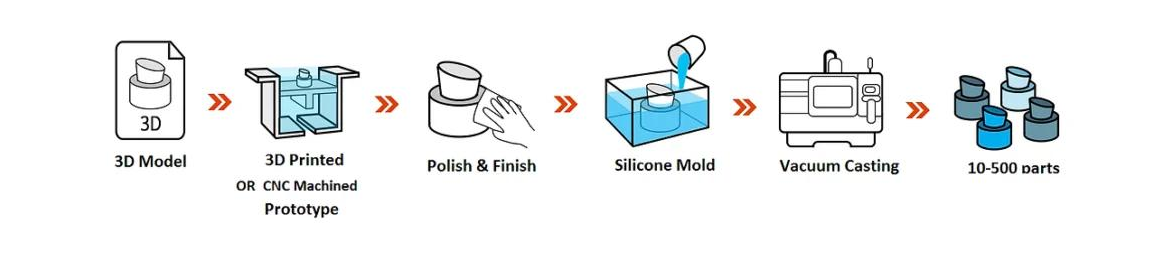
Comment construire des pièces coulées sous vide?
Le processus de coulée sous vide comprend plusieurs étapes de fabrication contrôlées:
Étape 1: Création de modèle maître
Vous avez d'abord besoin d'un modèle maître précis créé via:
- Usinage CNC
- SLA ou autres technologies d'impression 3D
- Finition de surface de précision
La qualité du maître modèle affecte directement la précision de la coulée finale et l'aspect de la surface..
Étape 2: Préparation du moule en silicone
Une fois le modèle principal terminé, VOK crée un moule en silicone autour du modèle.
Cette étape se concentre sur:
- Conception de la structure du moule
- Optimisation des canaux d'air
- Planification des lignes de séparation
- Amélioration de la durabilité du moule
Les moules en silicone offrent une option d'outillage rentable par rapport aux moules d'injection traditionnels.
Étape 3: Processus de coulée sous vide
Pendant le casting, la résine polyuréthane liquide est mélangée et versée dans le moule en silicone sous vide.
L'environnement sous vide aide:
- Élimine les bulles d'air emprisonnées
- Améliorer la distribution du matériel
- Maintenir une qualité constante des pièces
- Obtenez une reproduction détaillée de la surface
La température et le temps de durcissement sont soigneusement contrôlés pour garantir des performances mécaniques stables.
Étape 4: Traitement final et inspection
Après durcissement, la pièce moulée est retirée du moule et subit des processus de finition, y compris:
- Polissage des surfaces
- Peinture
- Assemblée
- Contrôle dimensionnel
VOK maintient des procédures de contrôle de qualité pour garantir que les pièces prototypes répondent aux spécifications du client..
Avantages clés du service de coulée sous vide
Choisir un professionnel service de coulée sous vide vous aide à réaliser des prototypes fiables sans coûts d'outillage initiaux importants.
| Fonctionnalité | Coulée sous vide | Moulage par injection |
|---|---|---|
| Coût de l'outillage | Investissement moindre dans le moule en silicone | Coût du moule en acier plus élevé |
| Volume de production | Idéal pour la production à faible volume | Convient à la production de masse |
| Délai de mise en œuvre | Moules en silicone créés en quelques jours | Préparation d'outillage plus longue |
| Options matérielles | ABS, PC, POM, PP, caoutchouc, silicone | Limité par la conception du moule |
| Validation des prototypes | Excellent pour les tests fonctionnels | Mieux pour la production finale |
Les principaux avantages comprennent:
Fabrication de précision
Le moulage sous vide VOK atteint une précision dimensionnelle d'environ 100 mm/± 0,20 mm, aider les ingénieurs à valider la conception des produits avant la production en série.
Outillage à faible coût
Les moules en silicone nécessitent moins d'investissement que les moules à injection. Cela rend la coulée sous vide adaptée à:
- Tests de produits
- Évaluation du marché
- Production en petits lots
- Vérification technique
Polyvalence des matériaux
Vous pouvez sélectionner des matériaux avec des propriétés différentes, y compris:
- Polyuréthane de type ABS
- Résine de type PC
- Matériaux semblables au caoutchouc
- Matériaux en silicone
- Élastomères flexibles
Ces options permettent aux prototypes de simuler les performances des produits finaux.
Délai d'exécution rapide
Parce que les moules en silicone peuvent être produits rapidement, la coulée sous vide prend en charge des cycles de développement de produits rapides et contribue à réduire le temps écoulé entre la conception et les tests.
Solutions de surmoulage par coulée sous vide
Le surmoulage par coulée sous vide est un processus avancé qui combine deux ou plusieurs matériaux ou composants en une seule pièce finie..
VOK propose des solutions de surmoulage personnalisées, y compris:
- Surmoulage en plastique rigide et caoutchouc
- Surmoulage en métal et plastique rigide
- Surmoulage de métal et de plastique en caoutchouc
- Insérer un surmoulage
Cette technologie est utile lorsque vous avez besoin de produits avec:
- Surfaces douces au toucher
- Performances d'adhérence améliorées
- Fonctions matérielles multiples
- Composants métalliques intégrés
Par exemple, composants automobiles, boîtiers électroniques, et les poignées industrielles utilisent souvent le surmoulage pour améliorer les performances du produit et l'expérience utilisateur.
Pourquoi choisir VOK pour le moulage d'uréthane?
VOK se concentre sur la fourniture de solutions complètes de fabrication rapide, du développement de prototypes à la production en faible volume..
Avec le soutien d’un ingénieur professionnel, VOK aide ses clients à obtenir des résultats fiables grâce à:
- Processus de fabrication de prototypes expérimentés
- Capacités d’usinage CNC et d’impression 3D
- Procédures strictes de contrôle de qualité
- Sélection de matériaux personnalisés
- Quantités de production flexibles
VOK soutient ses clients mondiaux avec leurs exigences en matière de développement de prototypes et fournit des solutions de fabrication pour des secteurs tels que l'automobile., électronique, équipement médical, et produits industriels.
FAQ
1. Combien de pièces un moule en silicone peut-il produire?
Un moule en silicone peut généralement produire plusieurs pièces prototypes en fonction du matériau., conception de pièces, et les exigences de production. Il est couramment utilisé pour la production en petits lots.
2. Quels matériaux peuvent être utilisés pour le moulage d'uréthane?
Les matériaux courants incluent la résine de type ABS, Résine de type PC, Matériaux de type POM, matériaux de type polypropylène, matériaux en caoutchouc, et du silicone.
3. La coulée sous vide est-elle adaptée à la production de masse?
La coulée sous vide est principalement conçue pour les prototypes et la production en faible volume. Pour la fabrication en grand volume, le moulage par injection pourrait devenir plus économique.
Conclusion
Lorsque vous avez besoin de prototypes précis, matériaux souples, et une production rentable en petites séries, Moulage d'uréthane offre une solution de fabrication pratique. En combinant la technologie des moules en silicone, contrôle précis de la production, et un délai d'exécution rapide, VOK vous aide à transformer efficacement des concepts de produits en pièces prototypes fonctionnelles.
De la validation du produit aux exigences du service de coulée sous vide, VOK fournit un support de fabrication personnalisé aux ingénieurs, créateurs, et les entreprises à la recherche de solutions prototypes fiables.
Obtenez votre devis de coulée sous vide personnalisé auprès de VOK
Envoyez vos dessins 3D ou vos besoins en prototypes à VOK aujourd'hui. Notre équipe d’ingénierie peut évaluer votre projet, recommander des matériaux adaptés, et fournir un personnalisé Moulage d'uréthane solution pour vos besoins de développement de produits.