Lorsque votre conception passe de la CAO aux tests physiques, dimensions inexactes, matériaux inappropriés, and long production lead times can delay product development. Pièces prototypes CNC help you evaluate real designs using production-grade metals and plastics before committing to larger manufacturing runs. Cependant, choosing the right machining partner requires more than comparing prices. You need a manufacturer that understands your design requirements, spécifications matérielles, dimensional tolerances, and intended application.
VOK Precision Technology Co., Ltée. provides CNC milling, Tournage CNC, and customized machining services for engineers and product developers. Avec plus 1,000 des clients mondiaux et des dizaines de milliers de projets réalisés, VOK supports prototype development and production needs across automotive, aérospatial, électronique, automation, et d'autres industries.
Why Choose CNC Prototype Parts for Product Development?
CNC machining removes material from a workpiece through computer-controlled cutting operations. Unlike processes that build parts layer by layer, it produces components directly from solid metal or plastic stock.
Pour votre projet, this approach offers several practical advantages:
- Production-grade materials: Evaluate aluminum, acier, laiton, cuivre, ABS, POM, PC, COUP D'OEIL, and other available materials.
- Dimensional accuracy: Develop parts with defined tolerances for assembly checks, test d'ajustement, and functional evaluation.
- Design flexibility: Modify CAD files and machine revised components as your design evolves.
- Multiple production stages: Move from initial prototypes to low-volume production without changing to an entirely different manufacturing process.
Par exemple, if you are developing a robotic bracket, you can machine an aluminum prototype, check mounting-hole alignment, and test assembly clearance before ordering a larger quantity.
CNC Milling and Turning Capabilities at VOK
VOK provides CNC milling and turning for parts with different geometries, exigences matérielles, and functional purposes.
CNC Milling for Complex Components
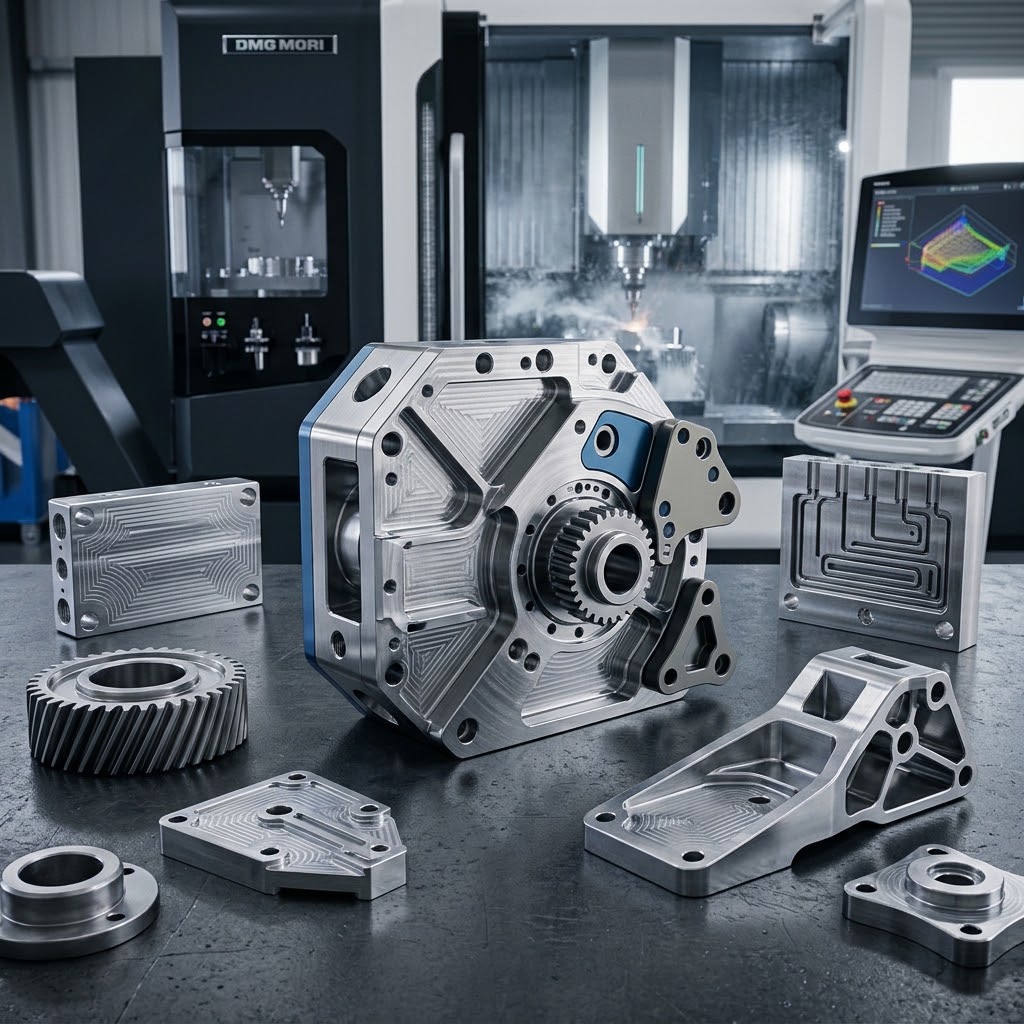
CNC milling works well for components that require flat surfaces, machines à sous, poches, mounting holes, and multiple machined features. VOK lists four-axis and five-axis machining, along with EDM and wire cutting capabilities.
These processes may suit robotics housings, aerospace-related components, custom fixtures, and mechanical parts with complex geometries. Actual feasibility depends on the part drawing, matériel, dimensions, and required tolerances.
CNC Turning for Rotational Parts
CNC turning is suitable for cylindrical components such as shafts, bagues, spacers, and threaded parts. VOK also offers turning and milling capabilities, allowing suitable components to receive multiple machining operations.
VOK lists a turning tolerance of ±0.005 mm per 100 mm and a metal machining tolerance of ±0.01 mm per 100 mm. These are stated capability figures, not guaranteed tolerances for every feature. Confirm achievable tolerances against your drawings and inspection requirements before production.
Materials for Custom CNC Prototype Parts
Material selection affects machining behavior, component weight, force, état de surface, and cost. VOK’s listed material options cover a broad range of engineering applications.
| Material group | Examples listed by VOK | Applications potentielles |
|---|---|---|
| Aluminium | AL6061, AL7075, AL6083 | Housings, parenthèses, lightweight structural parts |
| Steel and stainless steel | AISI 4140, AISI 1215, SUS304, SUS303, SUS17-4PH | Arbres, fixtures, composants mécaniques |
| Copper alloys | Laiton, cuivre, bronze | Electrical and conductive components |
| Engineering plastics | ABS, POM, Pennsylvanie, PA+GF, PPS, COUP D'OEIL, Delrin | Housings, gears, functional test parts |
| Other plastics | PMMA, PC, G10 | Covers, transparent components, insulating parts |
Before selecting a material, consider operating temperature, mechanical loads, chemical exposure, and whether the prototype must reproduce the final product’s functional behavior.
CNC Machining Compared With Other Prototyping Methods
VOK also lists 3D printing, fabrication de tôle, coulée sous vide, outillage rapide, et moulage par injection. The most suitable method depends on your design and production requirements.
| Method | Best suited for | Main consideration |
|---|---|---|
| Usinage CNC | Precision metal and plastic parts | Requires suitable cutting access and material removal |
| 3Impression D | Complex geometries and early design iterations | Material properties depend on the printing process |
| Vacuum casting | Small batches of cast polymer parts | Requires master patterns and casting molds |
| Moulage par injection | Repeated production of molded plastic parts | Tooling costs must be considered |
If your prototype needs machined metal surfaces, accurate mounting features, or evaluation in a production-grade material, CNC machining may be a practical choice. For intricate internal geometries or an early visual model, another process may be more appropriate.
How to Order CNC Prototype Parts
A clear request helps your manufacturer evaluate feasibility and provide a more useful quotation.
- Prepare your design files. Supply a 3D CAD model and dimensioned engineering drawings when available. Identify critical dimensions, fils de discussion, surface finishes, and tolerances.
- Specify material and quantity. State the required alloy or plastic grade and the number of prototypes or production parts.
- Explain the intended application. Describe assembly interfaces, expected loads, environmental conditions, and functional testing requirements.
- Confirm manufacturing details. Discuss machining methods, secondary operations, exigences d'inspection, and any finishing such as anodizing, peinture, or polishing.
- Review the quotation and production plan. Confirm pricing, délai de mise en œuvre, material availability, and acceptance criteria before authorizing production.
This process reduces avoidable revisions and helps align the prototype with your actual engineering objectives.
FAQ
1. What files do you need for CNC prototype parts?
A 3D CAD file and dimensioned drawing are ideal. Include material specifications, critical tolerances, surface finish requirements, and quantity so the manufacturer can assess your project accurately.
2. Can CNC prototype parts be used for functional testing?
Oui. CNC machining can produce parts from production-grade metals and plastics, making it useful for fit checks, assembly trials, and functional testing. Suitability depends on the selected material, design, and operating conditions.
3. Can I order low-volume CNC machined parts?
VOK states that its services cover early-stage prototyping through volume production. Contact the team with your required quantity and drawings to confirm the available production options, pricing, et délai de livraison.
Conclusion
Choisir le bon Pièces prototypes CNC manufacturer helps you validate designs, evaluate material performance, and prepare for the next stage of product development. VOK Precision Technology Co., Ltée. offers CNC milling, turning, multi-axis machining, metal and plastic processing, and surface finishing to support customized engineering projects. Partagez vos dessins, exigences matérielles, tolérances, and target quantity to determine the most suitable manufacturing approach.
Appel à l'action
Send your CAD files or engineering drawings to VOK Precision at inquiry@vokmodel.com or call +86 18124139075. Include your material, quantité, critical tolerances, and target delivery date to request a project-specific quotation.