Quand vous avez besoin rapidement de prototypes fonctionnels, les outils traditionnels peuvent générer des coûts et des retards inutiles. Coulée sous vide pour un prototypage rapide vous offre une alternative pratique en combinant des moules en silicone, matériaux en polyuréthane, et traitement sous vide contrôlé. Vous pouvez produire des pièces prototypes très détaillées et de petites séries de production sans investir dans des moules à injection coûteux..
Chez VOK PRECISION TECHNOLOGY Co., LTD, vous pouvez utiliser la coulée sous vide dans le cadre d'un flux de fabrication rapide plus large. Avec 20+ années d'expérience dans l'industrie, 200+ personnel, une base de production de 3 000㎡, et plus que 5,000 projets par an, VOK soutient les ingénieurs et les développeurs de produits dans le secteur automobile, médical, aérospatial, électronique, et applications d'automatisation.
Pourquoi utiliser le moulage sous vide pour le prototypage rapide?
Le moulage sous vide fonctionne particulièrement bien lorsque vous avez besoin de plus qu'un modèle visuel. Il peut reproduire des détails fins, texture des surfaces, et caractéristiques fonctionnelles d'un modèle maître tout en maintenant les coûts d'outillage relativement bas.
Le procédé utilise un moule en silicone plutôt qu'un moule à injection classique. Par conséquent, vous pouvez passer d'un modèle maître fini à des pièces prototypes dans un cycle de développement beaucoup plus court.
Vous pouvez bénéficier du moulage sous vide lorsque vous en avez besoin:
- Prototypes fonctionnels pour tests de produits
- Production en petites séries avant la fabrication en série
- Plusieurs pièces prototypes avec une géométrie cohérente
- Différentes propriétés des matériaux ou finitions de surface
- Formes complexes nécessitant une reproduction détaillée
- Investissement en outillage inférieur à celui du moulage par injection
Par exemple, une équipe d'ingénierie automobile peut utiliser des pièces moulées sous vide pour évaluer un composant intérieur avant de s'engager dans l'outillage de production. De la même manière, une entreprise d'électronique peut produire des prototypes de boîtiers pour l'assemblage et les tests d'ajustement.
Comment fonctionne la coulée sous vide pour le prototypage rapide
Un résultat fiable commence par un modèle maître précis et un processus de fabrication de moules contrôlé. VOK combine l'impression 3D ou l'usinage CNC avec le moulage sous vide pour créer un flux de travail de prototype pratique.
Étape 1: Créer le modèle maître
Vous avez d’abord besoin d’un modèle maître précis. En fonction de votre conception et de vos exigences de tolérance, vous pouvez le créer par impression 3D ou usinage CNC.
Le modèle principal détermine la précision dimensionnelle et les détails de surface transférés au moule en silicone.
Étape 2: Préparez le moule en silicone
Une fois le modèle maître terminé, VOK prépare le moule en silicone autour du modèle. Le moule doit capturer la géométrie requise tout en permettant également au moulage fini d'être retiré en toute sécurité..
Cette étape est importante lorsque votre pièce comporte des contre-dépouilles, parois minces, ou des fonctionnalités complexes.
Étape 3: Effectuer une coulée sous vide
Le matériau de coulée sélectionné est mélangé et versé dans le moule en silicone sous vide.. Le traitement sous vide aide à réduire l'air emprisonné et permet une distribution plus cohérente des matériaux.
Vous devez également contrôler le mélange des matériaux, température, temps de durcissement, et des conditions de vide pour obtenir des résultats stables.
Étape 4: Retirer et terminer la pièce
Après durcissement, la pièce moulée est retirée du moule en silicone. VOK peut ensuite effectuer le traitement final selon les exigences de votre projet.
Selon l'application, vous devrez peut-être couper, finition de surface, peinture, ou autre post-traitement avant test ou assemblage.
Coulée sous vide vs. Moulage par injection
Les deux technologies peuvent produire des composants en plastique, mais ils servent différentes étapes de développement de produits.
| Facteur | Coulée sous vide | Moulage par injection |
|---|---|---|
| Outillage | Moule en silicone | Moule de production |
| Coût initial de l'outillage | Inférieur | Plus haut |
| Vitesse de développement | Rapide | Préparation d'outillage plus longue |
| Volume de production | Prototypes et petits lots | Production de moyenne à grande série |
| Validation de la conception | Excellent | Mieux pour la production finale |
| Options matérielles | ABS-, PC-, POM-, Options de type PP et élastomère | Large gamme de matériaux de qualité production |
| Meilleure application | Développement et validation de produits | Fabrication à grande échelle |
Donc, la coulée sous vide est plus logique lorsque vous devez valider une conception avant de réaliser un investissement important dans l'outillage de production.
Principaux avantages de la coulée sous vide VOK
VOK se concentre sur les exigences pratiques auxquelles vous êtes confronté lors du développement de produits: coût, vitesse, précision, et sélection des matériaux.
Précision et détail
Le processus de coulée sous vide de VOK peut atteindre une tolérance déclarée d'environ ±0,20 mm par 100 mm, en fonction de la géométrie de la pièce, matériel, conception de moule, et conditions de traitement.
Cela rend le processus adapté aux contrôles dimensionnels, évaluation de l'assemblage, et tests de prototypes fonctionnels.
Outillage à faible coût
Les moules en silicone nécessitent généralement moins d'investissement initial que les moules à injection. Cela vous donne un itinéraire plus économique lorsque votre projet ne nécessite qu'un nombre limité de pièces.
Il est particulièrement utile au stade précoce du développement, quand des modifications de conception sont encore possibles.
Polyvalence des matériaux
Vous pouvez sélectionner des matériaux ayant des propriétés similaires aux plastiques et élastomères couramment utilisés., y compris des options similaires à:
- ABS
- PC
- POM
- PP
- Caoutchouc
- Silicone
Cette flexibilité vous permet d'évaluer différentes caractéristiques mécaniques et d'aspect avant la production finale.
Délai d'exécution rapide
Les moules en silicone peuvent généralement être préparés en quelques jours, en fonction de la complexité de la pièce et des exigences du projet. Parce que vous évitez les outils de production conventionnels, vous pouvez raccourcir le chemin depuis la conception du prototype jusqu'à la validation physique.
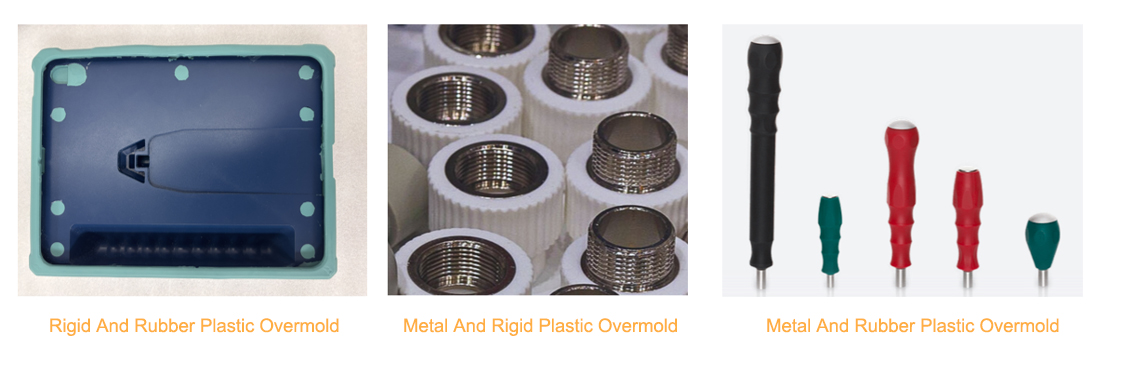
Surmoulage par coulée sous vide pour prototypes complexes
Si votre prototype combine différents matériaux ou composants, le surmoulage par coulée sous vide peut fournir une autre option utile.
VOK prend en charge plusieurs configurations de surmoulage, y compris:
- Surmoulage de plastique rigide et caoutchouc
- Surmoulage de métal et plastique rigide
- Surmoulage métal et caoutchouc plastique
- Insérer un surmoulage
Par exemple, vous aurez peut-être besoin d'un boîtier rigide avec une poignée en caoutchouc souple pour un produit électronique portable. Au lieu de tester les composants séparément, le surmoulage vous permet d'évaluer leur interaction comme un seul assemblage prototype.
Pourquoi choisir VOK pour le prototypage rapide?
VOK PRÉCISION TECHNOLOGIE Co., LTD a réalisé des dizaines de milliers de projets depuis plus de 1,000 clients mondiaux. Ses capacités de fabrication couvrent l'usinage CNC, Tournage CNC, 3Impression D, fabrication de tôle, coulée sous vide, outillage rapide, et moulage par injection.
Cette capacité intégrée signifie que vous pouvez passer d'un processus de fabrication à l'autre au fur et à mesure du développement de votre projet.. VOK maintient également des pratiques documentées de certification et de contrôle de la qualité., avec des informations de certification disponibles via les ressources de son entreprise.
FAQ
La coulée sous vide est-elle adaptée à la production en petites séries?
Oui. La coulée sous vide est particulièrement utile lorsque vous avez besoin d'une quantité limitée de pièces fonctionnelles avant de passer à la production de masse.. L'outillage en silicone maintient l'investissement initial inférieur à celui du moulage par injection conventionnel.
Quels matériaux peuvent être utilisés pour la coulée sous vide?
Les options courantes incluent des matériaux en polyuréthane conçus pour simuler l'ABS, PC, POM, PP, caoutchouc, et propriétés similaires à celles du silicone. Votre choix de matériau doit dépendre de la résistance requise, flexibilité, apparence, et candidature.
Quelle est la précision des pièces moulées sous vide?
VOK spécifie une tolérance d'environ ±0,20 mm par 100 mm. Les résultats réels dépendent de la taille de la pièce, géométrie, conception de moule, caractéristiques des matériaux, et contrôle des processus.
Conclusion
Lorsque vous avez besoin de pièces détaillées sans le coût et les délais de production des outils de production, coulée sous vide pour un prototypage rapide fournit un chemin pratique depuis la validation de la conception jusqu'à la fabrication en petits lots. Avec des matériaux flexibles, outillage en silicone, préparation rapide du moule, et environ ±0,20 mm par 100 mm tolérance déclarée, vous pouvez tester l'ajustement, fonction, apparence, et l'assemblage avant de se lancer dans la production de masse. VOK PRÉCISION TECHNOLOGIE Co., LTD combine la coulée sous vide avec l'usinage CNC, 3Impression D, fabrication de tôle, outillage rapide, et moulage par injection, vous offrant un partenaire de fabrication complet pour le développement de prototypes.
Appel à l'action
Envoyer VOK votre fichier CAO 3D, dessins, quantité requise, préférence matérielle, et les détails de la candidature. L'équipe peut examiner vos besoins et recommander un service de coulée sous vide adapté à votre prototype ou projet de production en faible volume..