When a plastic part looks right in a CAD model, can you be sure it will perform as expected in production? Design flaws, comportamento material, custos de ferramentas, and delayed sample approval can turn a promising project into an expensive redesign. Rapid mold prototyping helps you evaluate plastic part designs, test mold performance, and identify potential manufacturing issues before committing to full-scale production.
Para engenheiros, designers de produtos, and procurement teams, the challenge is finding the right balance between development speed, qualidade da peça, e custo de produção. TECNOLOGIA DE PRECISÃO VOK Co., LTD fornece prototipagem rápida, usinagem de precisão, ferramentas rápidas, and injection molding services to help you move from design validation toward repeatable manufacturing. Com mais 1,000 global clients and more than 5,000 projetos concluídos anualmente, VOK supports product development across automotive, médico, aeroespacial, eletrônica, e aplicações de automação.
What Is Rapid Mold Prototyping?
Rapid mold prototyping is a manufacturing approach that uses quickly developed molds and trial molding to evaluate plastic part designs before investing in production tooling. It allows you to assess part geometry, ajuste de montagem, surface appearance, and selected functional requirements using molded samples.
Unlike CNC machining or 3D printing, which create parts through material removal or layer-by-layer fabrication, mold-based prototyping produces parts by injecting plastic into a cavity. This makes it particularly useful when you need to understand how a component behaves under actual molding conditions.
When Should You Use Rapid Tooling?
Rapid tooling is worth considering when you need to:
- Validate a plastic housing, enclosure, connector, or mechanical component before mass production.
- Check assembly tolerances and fit with neighboring components.
- Evaluate surface finish, espessura da parede, and potential molding defects.
- Produce bridge quantities while final production tooling is being prepared.
- Reduce the risk of expensive tooling changes after design approval.
The best approach depends on your part geometry, resin requirements, expected volume, and testing objectives. Discussing these factors early helps you avoid investing in a mold that does not match your production needs.
Rapid Mold Prototyping vs. Moldagem por injeção
Rapid tooling and production injection molding serve different stages of product development. Rapid tooling prioritizes development speed and design validation, while production tooling focuses on repeatability, cycle efficiency, and long-term manufacturing economics.
| Recurso | Ferramentas Rápidas | Moldagem por injeção de produção |
|---|---|---|
| Investimento inicial em ferramentas | Geralmente mais baixo | Geralmente mais alto |
| Prazo de desenvolvimento | Typically shorter | Usually longer for new production molds |
| Aplicação típica | Protótipos e produção de pontes | Médio- and high-volume production |
| Flexibilidade de projeto | Useful for early design changes | Changes may require costly mold modifications |
| Part cost at scale | May be higher per part | Often lower at sufficient volumes |
| Main objective | Validate design and process | Maintain consistent output efficiently |
Actual costs and lead times depend on mold complexity, cavity count, seleção de materiais, tooling life, e requisitos de qualidade. For some projects, rapid tooling can also support low-volume manufacturing without immediately requiring a dedicated production mold.
VOK evaluates your projected volume, target schedule, and budget to help you choose an appropriate manufacturing route.
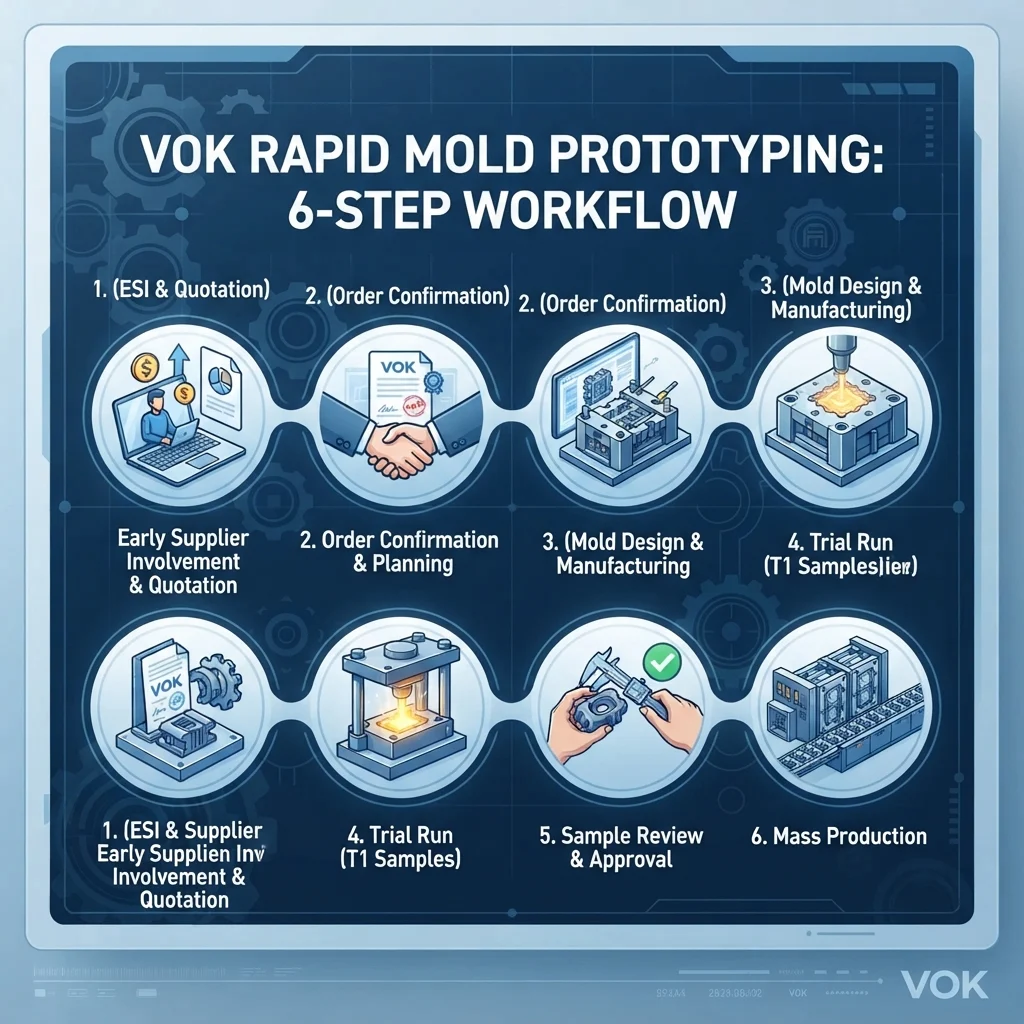
VOK’s 6-Step Injection Molding Process
A structured workflow helps you identify problems early and maintain clear approval points throughout mold development.
- Envolvimento inicial do fornecedor (ESI) and Quotation: Share your 3D CAD files, desenhos, requisitos de materiais, and target quantities. VOK reviews the project scope and provides a quotation for evaluation.
- Order Confirmation and Planning: Confirm the project requirements, delivery expectations, and tooling plan. Resolve outstanding design questions before mold manufacturing begins.
- Projeto e fabricação de moldes: The team develops and manufactures the mold according to the agreed part geometry and production requirements.
- Teste: Produce initial molded samples to evaluate dimensions, aparência, ajustar, and other agreed acceptance criteria.
- Sample Review and Approval: Test the samples against your drawings and functional requirements. Request necessary adjustments and approve the samples before proceeding.
- Produção em massa: After sample approval and production readiness checks, move into the agreed production phase with defined quality requirements.
This process gives your engineering team an opportunity to review real molded parts rather than relying entirely on digital models. Early feedback can also help reduce the risk of discovering design or tooling issues after production has started.
Two-Shot Injection Molding and Metal Insert Overmolding
Different products require different molding techniques. VOK’s showcased projects include two-shot injection molding and metal insert overmolding, which address specific component design and integration needs.
Moldagem por injeção de dois disparos
Two-shot injection molding combines two material shots in a single molding process to create a component with distinct materials or colors. Depending on the material combination and mold design, this approach can support integrated product features and reduce the need for separate assembly operations.
It may suit product housings, controls, punhos, and components that require different surface properties. Material compatibility and bonding performance should be assessed during development.
Sobremoldagem de Inserção Metálica
A sobremoldagem de inserto de metal incorpora um inserto de metal em um componente plástico moldado. It can help combine the structural or fastening properties of metal with the design flexibility of plastic.
Potential applications include threaded fastening points, componentes elétricos, and mechanical assemblies. Insert positioning, plastic flow, compatibilidade de materiais, and dimensional stability should be reviewed during mold trials.
Why Work With VOK for Rapid Tooling?
TECNOLOGIA DE PRECISÃO VOK Co., LTDA provides multiple manufacturing services under one supplier, incluindo usinagem CNC e torneamento, SLA/SLS/FDM 3D printing, fabricação de chapas metálicas, fundição de uretano, ferramentas rápidas, e moldagem por injeção.
Its company profile lists more than 20 anos de experiência no setor, sobre 200 funcionários, um 3,000 base de produção m², e mais do que 5,000 projetos por ano. VOK also reports serving over 1,000 clientes globais.
Para o seu projeto, these capabilities can support a more coordinated development process, particularly when plastic components need machined features, complementary metal parts, or prototypes made using different processes.
Before placing an order, confirm the specific resin grades, tolerâncias dimensionais, métodos de inspeção, applicable certifications, and sample acceptance criteria required for your application. These details help establish clear quality expectations and reduce misunderstandings during production.
Perguntas frequentes
1. How is rapid mold prototyping different from 3D printing?
Rapid mold prototyping uses a mold to form plastic parts, while 3D printing builds parts layer by layer. Molded prototypes are useful for evaluating injection-molded geometry and process behavior; 3D printing can be more convenient for early design iterations without mold fabrication.
2. Is rapid tooling suitable for low-volume production?
Sim. Rapid tooling can support bridge production and some low-volume projects. Suitability depends on the mold material, expected part quantity, resina, geometria, and required tooling life.
3. What information should you provide for an injection mold quotation?
Prepare your 3D CAD model, 2D drawings, especificação de materiais, estimated order quantity, target delivery date, e requisitos de qualidade. If available, include assembly details and testing criteria so the supplier can evaluate the project more accurately.
Conclusão
Rapid mold prototyping gives you a practical way to evaluate plastic part designs, assess tooling performance, and prepare for low-volume or mass production. By comparing rapid tooling with production injection molding and defining sample approval criteria early, you can make better-informed decisions about development cost, timing, and manufacturing readiness.
TECNOLOGIA DE PRECISÃO VOK Co., LTD combines rapid prototyping, ferramentas, and injection molding capabilities to support your project from initial design evaluation to production.
Request a Rapid Tooling Review
Enviar VOK your CAD files, target material, volume de produção esperado, and project timeline. The team can review your requirements and help identify a suitable tooling and injection molding strategy for your application.