Metal rapid prototyping helps you turn digital designs into physical metal parts without committing to expensive production tooling at an early stage. If you need to validate a product design, check component fit, or test a part under real operating conditions, choosing the right manufacturing method can save development time and reduce costly design changes.
However, metal prototypes require more than a suitable 3D printer. You must consider material properties, dimensional requirements, surface finish, part geometry, and the intended application. VOK Precision Technology Co., Ltd. provides rapid prototyping, precision machining, and low-volume manufacturing services to help engineers and product developers move from CAD models to physical components. With more than 20 years of industry experience, a team of over 200 staff, and a 3,000 m² production base, VOK supports projects across automotive, medical, aerospace, electronics, and automation industries.
What Is Metal Rapid Prototyping?
Metal rapid prototyping uses digital design data and suitable manufacturing processes to produce metal components for design validation, functional testing, and product development. Depending on your project, you can use metal additive manufacturing or combine 3D printing with CNC machining to achieve the required geometry and dimensional accuracy.
Unlike conventional manufacturing routes that may require dedicated tooling, metal 3D printing can produce complex geometries directly from digital models. This makes it useful for early-stage development, customized components, and selected low-volume production applications.
Common Applications
You can use rapid metal prototyping to develop:
-
Automotive components: Brackets, housings, lightweight structural parts, and customized fixtures.
-
Aerospace prototypes: Complex metal geometries and components for design evaluation.
-
Automation equipment: Mounting brackets, mechanical connectors, and specialized machine parts.
-
Electronics enclosures: Custom housings and components that require precise integration.
-
Engineering prototypes: Functional parts for assembly checks, design iterations, and performance testing.
The appropriate process depends on the component’s geometry, mechanical requirements, and intended operating environment.
Metal 3D Printing Materials and Capabilities
Material selection directly affects the strength, weight, corrosion resistance, and manufacturing cost of your prototype. VOK lists several metal materials for its metal printing service, including aluminum alloys, titanium alloy, stainless steel, and nickel-based alloy options.
|
Material |
Typical characteristics | Potential applications |
|---|---|---|
|
AlSi10Mg |
Lightweight, good strength-to-weight ratio | Lightweight housings and complex components |
|
AL6061 |
Lightweight aluminum alloy commonly used in engineering | Brackets, fixtures, and machined components; process compatibility must be confirmed |
|
TC4 (Ti-6Al-4V) |
High strength-to-weight ratio and corrosion resistance |
Aerospace and specialized engineering prototypes |
| 316L stainless steel | Corrosion resistance and established engineering applications |
Industrial components and selected medical-related prototypes |
| 17-4PH stainless steel | High strength and heat-treatment potential |
Mechanical components and functional prototypes |
| GH3625 nickel-based alloy | Designed for demanding high-temperature environments |
Specialized industrial and thermal applications |
Important: Not every listed alloy is compatible with every metal 3D printing process. Confirm the available material grade, printing method, post-processing requirements, and applicable material certifications with your supplier before placing an order.
VOK also offers SLA and SLS 3D printing for projects that require plastic or resin prototypes rather than metal parts.
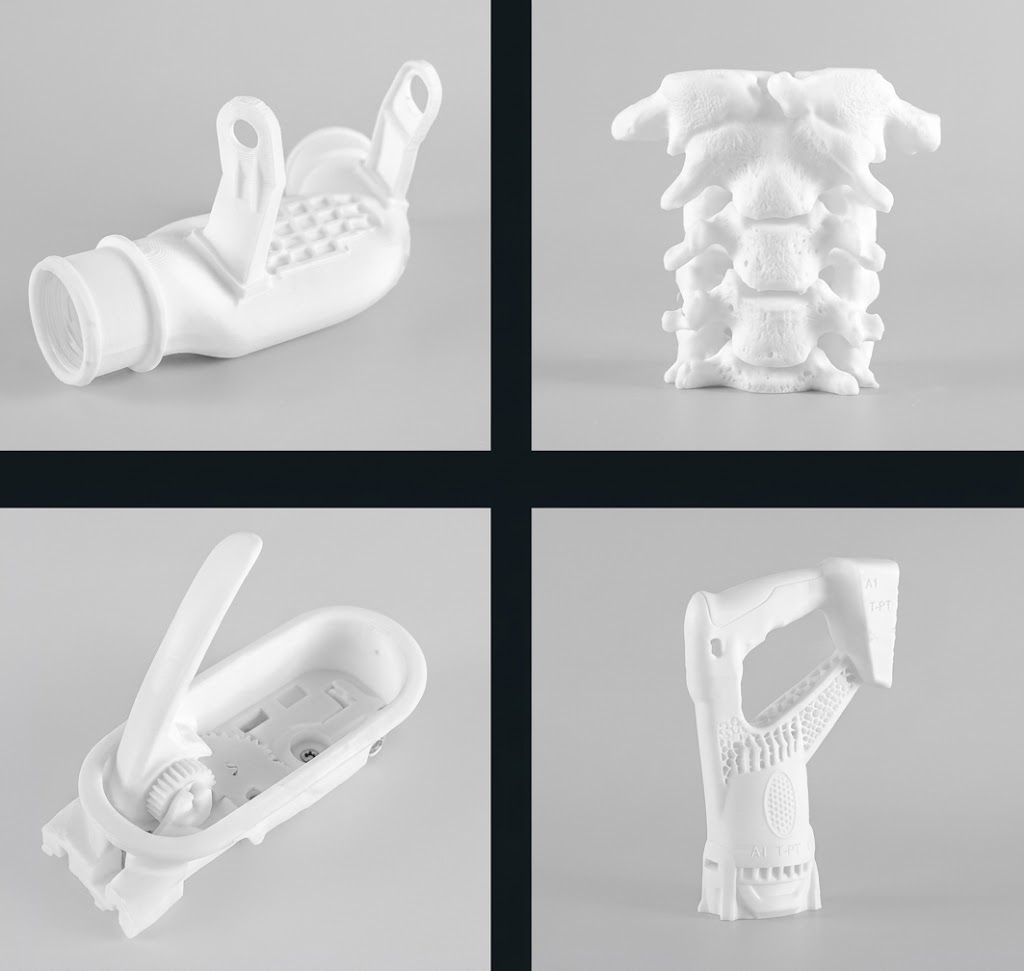
Metal 3D Printing vs. SLA vs. SLS
Choosing the right process helps you balance design complexity, prototype functionality, and budget.
|
Comparison factor |
Metal 3D printing | SLA printing | SLS printing |
|---|---|---|---|
|
Typical material |
Compatible metal alloys | Photopolymer resin | Polymer powder, such as PA12 |
|
Main advantage |
Produces metal geometries | Fine details and smooth surfaces | Functional plastic parts |
| Typical use | Metal component development | Appearance models and detailed prototypes |
Functional plastic prototypes |
| Post-processing | May require heat treatment, support removal, or machining | Washing, curing, and finishing |
Powder removal and optional finishing |
| Key consideration | Material, process capability, and part cost | Resin properties and durability |
Powder-based surface texture and dimensional requirements |
VOK lists the following process specifications:
-
SLA: Maximum build size of 600 × 600 × 350 mm, with a stated tolerance of ±0.05 mm.
-
SLS: Maximum build size of 410 × 350 × 350 mm, with a stated tolerance of ±0.1 mm.
-
Metal printing: Stated tolerance of 0.2–0.4 mm and surface roughness of Ra 6.3–7.
These figures are the capabilities stated for the respective services. Actual results depend on geometry, material, build orientation, and post-processing. Confirm the applicable specifications for your individual part before production.
How to Order Metal Rapid Prototyping Parts
A structured workflow helps you avoid unnecessary revisions and improve communication with your manufacturing partner.
-
Prepare your CAD files. Provide a 3D model in a suitable format, such as STEP or STL, along with engineering drawings when available.
-
Define functional requirements. Identify critical dimensions, tolerances, load conditions, temperature exposure, and corrosion requirements.
-
Select the material and process. Compare metal 3D printing with CNC machining or other suitable methods based on geometry, material availability, and budget.
-
Review the quotation. Confirm pricing, lead time, build dimensions, surface finish, inspection requirements, and any additional machining or heat treatment.
-
Validate the prototype. Check dimensional accuracy, fit, assembly compatibility, and functional performance before moving to low-volume manufacturing.
For complex parts, discuss critical features with your supplier before manufacturing. This allows the engineering team to identify potential design or process limitations early.
Why Work With VOK Precision Technology?
VOK Precision Technology Co., Ltd. supports product development through several complementary manufacturing services:
-
Rapid prototyping: 3D printing, urethane casting, and other prototype production options.
-
Precision machining: CNC milling and turning for components requiring specific dimensional features.
-
Sheet metal fabrication: Suitable processes for enclosures, brackets, and formed components.
-
Injection molding and rapid tooling: Options for projects progressing toward repeatable plastic part production.
-
Low-volume manufacturing: Support for pilot runs and smaller production batches.
VOK reports more than 1,000 global clients and over 5,000 projects per year. These figures provide context for its manufacturing experience, although the appropriate service and production capacity should be confirmed for each project.
When comparing suppliers, ask for relevant inspection reports, material certificates, and process-specific quality documentation. VOK’s published company information lists a certificate section, but you should verify the applicable certifications and their validity directly before relying on them for compliance requirements.
Frequently Asked Questions
1. How much does metal rapid prototyping cost?
The cost depends on material, part dimensions, geometry, build time, finishing, and inspection requirements. Providing a 3D CAD file and specifying your required quantity will help VOK prepare a project-specific quotation.
2. Is metal 3D printing suitable for functional prototypes?
Yes, when the selected material and manufacturing process meet your mechanical and environmental requirements. For load-bearing or safety-critical parts, confirm material properties, post-processing, and testing requirements before using the prototype in service.
3. Should I choose metal 3D printing or CNC machining?
Metal 3D printing is useful for complex geometries and designs that are difficult to manufacture conventionally. CNC machining is often suitable for parts requiring precise machined surfaces or specific dimensional tolerances. Your part geometry, material, quantity, and budget will determine the best option.
Conclusion
Metal rapid prototyping gives you a practical way to evaluate metal components, refine product designs, and identify manufacturing issues before committing to larger production runs. By selecting the right alloy, manufacturing process, and inspection requirements, you can make better development decisions and reduce avoidable rework.
VOK Precision Technology Co., Ltd. combines 3D printing with CNC machining, sheet metal fabrication, urethane casting, and low-volume manufacturing to support different stages of product development. Define your part’s material, dimensions, critical tolerances, and intended application to identify a suitable manufacturing approach.
Ready to develop your metal prototype? Prepare your CAD file, technical drawings, material preferences, and required quantity, then contact VOK Precision Technology at inquiry@vokmodel.com or +86 18124139075 to discuss your project and request a quotation.