Low volume manufacturing helps you validate a product design and produce functional parts without committing to expensive production tooling. However, choosing the wrong process can increase unit costs, delay testing, or create material differences between prototypes and finished products. If you need a limited batch of plastic components for engineering validation, market testing, or pre-production assembly, urethane casting offers a practical option worth evaluating.
VOK PRECISION TECHNOLOGY Co., LTD provides rapid prototyping, precision machining, vacuum casting, 3D printing, sheet metal fabrication, and injection molding. With more than 20 years of industry experience, over 200 staff members, a 3,000 m² production base, and more than 5,000 projects per year, VOK supports product development from early prototypes to low-volume production. Understanding how vacuum casting works helps you determine whether it fits your budget, timeline, and performance requirements.
What Is Urethane Casting in Low Volume Manufacturing?
Urethane casting, also called vacuum casting in many prototyping applications, uses a silicone mold to reproduce parts from a master model. Manufacturers typically pour a two-component polyurethane resin into the mold under vacuum, helping reduce trapped air and reproduce fine surface details.
Unlike conventional injection molding, this process does not require a hardened metal production mold. As a result, vacuum casting for rapid prototyping can suit projects that need several to dozens of parts, although the practical quantity depends on part geometry, mold life, material, and quality requirements.
Typical applications include:
- Product development: Produce housings, covers, buttons, and enclosure prototypes for design reviews.
- Functional testing: Evaluate fit, assembly, appearance, and selected mechanical properties before committing to production tooling.
- Market validation: Create presentation models or limited batches for demonstrations and early customer feedback.
- Pre-production assembly: Check component interfaces and identify design issues before scaling up.
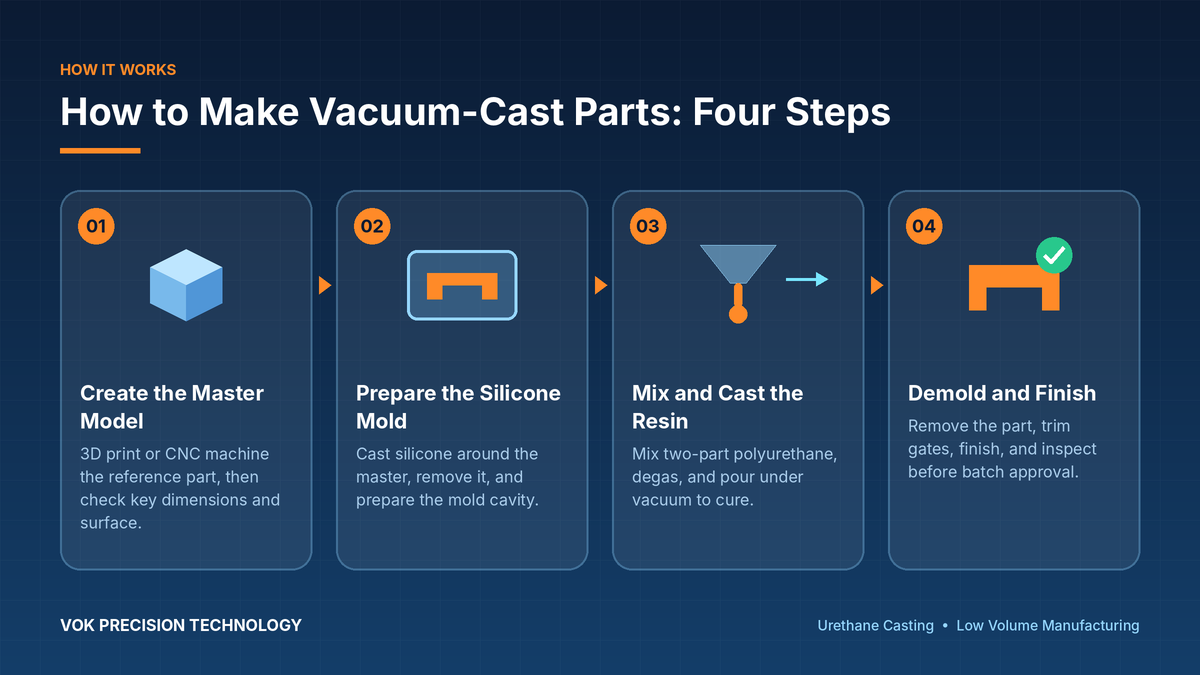
How to Make Vacuum-Cast Parts: Four Steps
A controlled manufacturing workflow helps you achieve consistent dimensions and surface quality.
- Create the master model. Use 3D printing or CNC machining to produce the reference part. Check critical dimensions, surface finish, and geometry before making the mold.
- Prepare the silicone mold. Apply the appropriate mold-making process around the master model, then remove the master and prepare the mold cavity. Mold design should account for part geometry, resin behavior, and demolding requirements.
- Mix and cast the resin. Select a suitable polyurethane resin, mix its components according to the manufacturer’s instructions, and degas the material when required. Pour the resin under vacuum, following the specified curing temperature and time to reduce air entrapment and incomplete filling.
- Demold and finish the parts. Remove the cured component, trim gates and excess material, and perform any required finishing. Inspect critical dimensions and visible surfaces before approving the batch.
For repeatable results, provide your manufacturer with a 3D CAD file, target quantity, material requirements, critical dimensions, surface-finish expectations, and intended application.
Key Advantages of Vacuum Casting for Low Volume Manufacturing
Lower Initial Tooling Investment
Silicone molds generally cost less and take less time to produce than production-grade injection molds. This makes urethane casting useful when you need a limited number of parts and want to avoid a large upfront tooling commitment.
However, silicone molds have a finite service life. If demand increases substantially, compare the cumulative cost of repeated casting with injection molding before choosing a long-term process.
Flexible Material and Appearance Options
Depending on the resin system, vacuum casting can produce parts that resemble common engineering plastics in appearance or selected properties. Options may include ABS-like, PC-like, PP-like, and rubber-like polyurethane materials.
These materials are not automatically equivalent to actual ABS, polycarbonate, polypropylene, or silicone. If your application requires specific chemical resistance, operating temperatures, flame performance, or regulatory compliance, confirm the resin’s technical data and test results before ordering.
Practical Lead Times for Prototype Batches
Silicone molds can often be prepared within days after the master model and design are approved. Actual delivery depends on part complexity, mold construction, curing requirements, finishing, and inspection.
For example, a product team developing a handheld electronic enclosure may use vacuum casting to evaluate assembly clearances and surface appearance before ordering injection-molded parts. The team can identify design changes earlier without immediately investing in production tooling.
Vacuum Casting vs. Injection Molding vs. CNC Machining
| Comparison factor | Vacuum casting | Injection molding | CNC machining |
|---|---|---|---|
| Initial tooling cost | Generally low | Generally high | Usually low to moderate |
| Suitable production stage | Prototypes and small batches | Repeated, larger-volume production | Prototypes and functional parts |
| Material options | Primarily cast resins | Broad range of moldable production plastics | Machinable plastics and metals |
| Design flexibility | Good for detailed molded shapes | Depends on mold design | Depends on tool access and geometry |
| Main limitation | Silicone mold life and resin properties | High upfront tooling investment | Material waste and geometric constraints |
The right process depends on your expected quantity, material requirements, tolerance, geometry, and budget. Vacuum casting is not automatically the lowest-cost option for every part; compare total project costs rather than unit prices alone.
Vacuum Casting Overmolding for Multi-Material Parts
Vacuum casting overmolding combines two or more materials or components in a single assembly. Depending on the design and compatible material systems, VOK can support configurations such as rigid plastic with rubber-like material, metal inserts with rigid plastic, and metal inserts with rubber-like material.
This approach can help you evaluate soft-touch surfaces, protective features, grips, and insert integration before committing to production tooling. Because adhesion, shrinkage, and material compatibility affect performance, confirm the proposed process with engineering trials when the interface is critical.
FAQ
1. How many parts can vacuum casting produce?
Vacuum casting is commonly used for prototypes and small batches, but there is no universal quantity limit. The practical output depends on mold durability, part size, geometry, resin selection, and inspection requirements.
2. What tolerance can you expect from vacuum casting?
Tolerance depends on part dimensions, mold design, resin shrinkage, and process control. VOK’s published service information lists a tolerance of ±0.20 mm for a 100 mm dimension. Treat this as a stated reference rather than a guarantee for every feature, and confirm critical tolerances on your drawing before production.
3. When should you choose injection molding instead?
Consider injection molding when demand is repeatable and high enough to justify production tooling, or when you need specific production-grade thermoplastics and tightly controlled manufacturing conditions. Vacuum casting is often more suitable for early validation and limited quantities.
Conclusion
Low volume manufacturing gives you a way to validate designs, control initial investment, and prepare products for wider production. Urethane casting is particularly useful when you need detailed plastic prototypes, flexible appearance options, or limited batches before committing to injection molding. By comparing tooling costs, material properties, expected quantities, and inspection requirements, you can select a process that supports both your development schedule and product goals.
Request a Vacuum Casting Evaluation from VOK
Contact VOK PRECISION TECHNOLOGY Co., LTD to discuss your next prototype or small-batch project. Share your CAD files, target quantity, material requirements, critical tolerances, and expected delivery date. VOK can help you evaluate vacuum casting, CNC machining, 3D printing, and injection molding options based on your project requirements.