Rubber part casting helps you develop flexible components, test product designs, and produce small batches without investing in expensive production tooling. If you need rubber-like prototypes for a new enclosure, a protective component, or an overmolded assembly, choosing the right casting process can reduce development costs and avoid unnecessary delays. Tuttavia, material flexibility, precisione dimensionale, and compatibility with other components all affect the final result.
VOK Precision Technology Co., Ltd. specializes in rapid prototyping, lavorazioni meccaniche di precisione, e produzione a basso volume. Its manufacturing services include urethane casting, Lavorazione CNC, 3Stampa D, fabbricazione di lamiere, attrezzaggio rapido, e stampaggio ad iniezione. Con oltre 1,000 clienti globali, more than 5,000 progetti all'anno, e un 3,000 base produttiva di m², VOK supports engineers and product developers from initial concepts to functional prototypes and small production runs.
What Is Rubber Part Casting?
Rubber part casting is a manufacturing approach used to create rubber-like components by pouring or dispensing a suitable liquid material into a prepared mold and allowing it to cure. In rapid prototyping, manufacturers often use vacuum casting with polyurethane materials formulated to simulate selected rubber properties.
Unlike conventional rubber molding, which may require specialized tooling and processing conditions, vacuum casting commonly uses silicone molds made from a master model. This approach is useful when you need a limited quantity of parts before committing to larger-scale production.
The final properties depend on the selected material rather than the process name alone. Before ordering, confirm the required hardness, elasticity, tear resistance, chemical compatibility, and operating temperature range.
How Does the Rubber Part Casting Process Work?
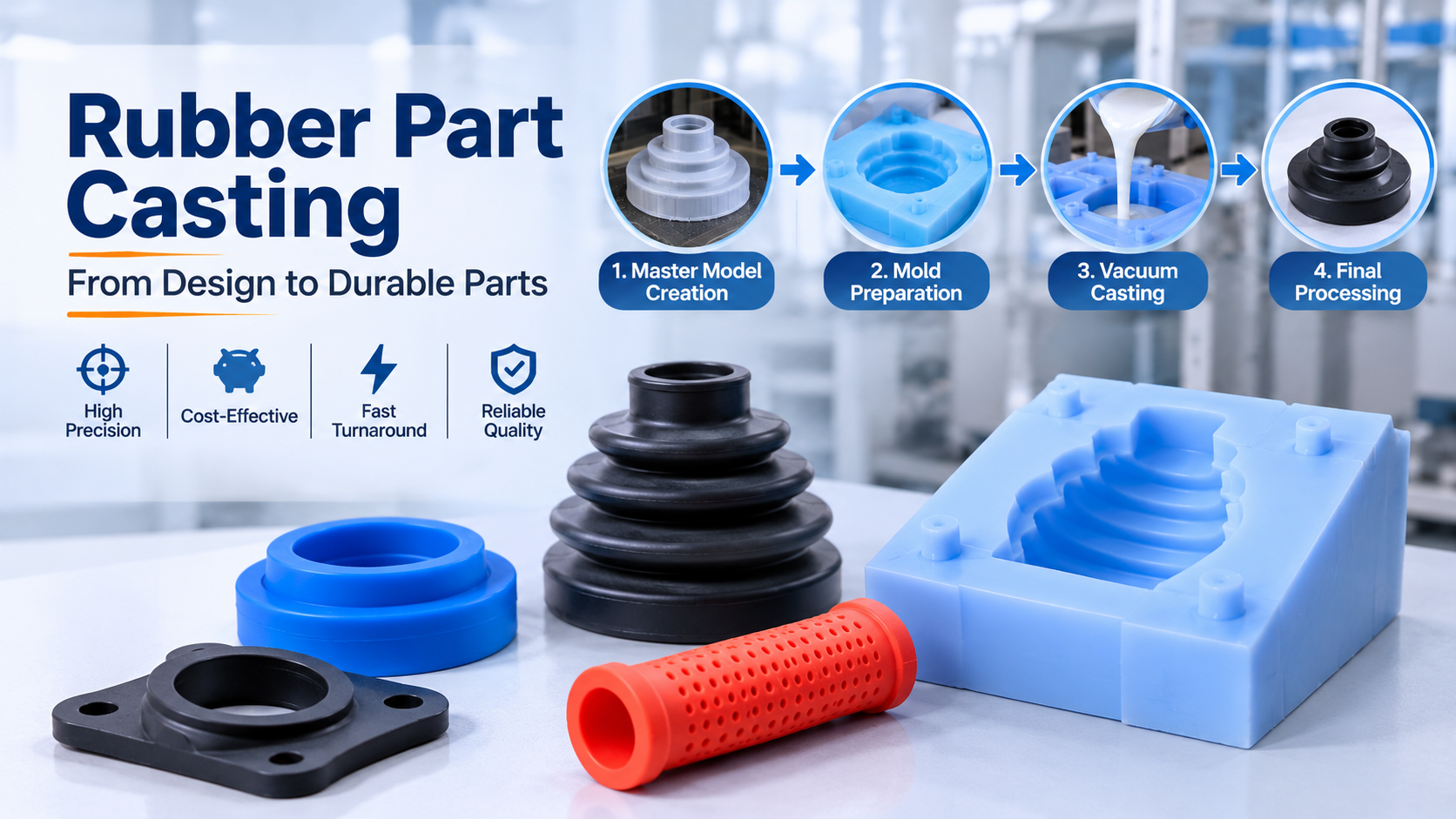
VOK’s urethane casting workflow can support prototype development and low-volume production through four main stages.
- Master model creation: Engineers prepare a master model using SLA 3D printing or CNC machining. The model should reflect the required dimensions, finitura superficiale, and critical features of your part.
- Silicone mold preparation: The master model is used to create a silicone mold. Mold design must account for part geometry, undercuts, parting lines, and the intended demolding method.
- Vacuum casting and curing: The selected casting material is mixed and poured into the mold under vacuum conditions where appropriate. Proper mixing, air removal, material distribution, and curing time help reduce voids and incomplete filling.
- Demolding and finishing: Dopo la polimerizzazione, the part is removed from the mold and undergoes trimming, visual inspection, and dimensional checks against the agreed specifications.
This process is particularly useful for evaluating the fit, feel, and function of a component before finalizing its production design.
Key Benefits of Rubber Part Casting
Lower Tooling Costs for Small Batches
Silicone molds generally cost less and take less time to prepare than production injection molds. This makes vacuum casting attractive when you need several prototypes or a limited batch for customer evaluation, verifica del progetto, or pilot assembly.
Flexible Material Options
A seconda dell'applicazione, manufacturers may offer polyurethane formulations that simulate rubber-like flexibility or other materials with rigid or semi-rigid properties. VOK also lists rubber and silicone among its material options, subject to project requirements and process compatibility.
When requesting a quotation, specify your target Shore hardness, expected deformation, colore, surface texture, ed esposizione ambientale. These details help determine whether a particular casting material is suitable.
Overmolding for Integrated Components
Vacuum casting overmolding combines two or more materials or components in a single assembly. VOK supports several configurations, compreso:
- Rigid plastic overmolded with rubber-like material.
- Metal inserts combined with rigid plastic.
- Metal inserts combined with rubber-like plastic.
- Insert overmolding for components that require integrated features.
Per esempio, a product developer may need a rigid housing with a softer grip or a protective outer layer. Overmolding can help create that combination, provided the selected materials offer adequate adhesion and process compatibility.
Practical Dimensional Control
VOK’s supplied reference lists a tolerance of ±0.20 mm for a 100 mm dimension. Treat this as a reference rather than a universal guarantee, because achievable tolerances depend on part geometry, material shrinkage, mold condition, and measurement requirements. Confirm critical dimensions with VOK before production.
Rubber Part Casting vs. Other Manufacturing Methods
| Fattore | Colata sottovuoto | Stampaggio ad iniezione | 3D Stampa |
|---|---|---|---|
| Initial tooling | Stampo in silicone | Stampo di produzione | Usually no dedicated mold |
| Best-fit application | Prototipi e piccoli lotti | Repeated, higher-volume production | Complex prototypes and design iterations |
| Selezione dei materiali | Depends on casting formulations | Depends on molding-compatible materials | Depends on printing technology |
| Modifiche alla progettazione | New or revised molds may be needed | Mold modifications can be costly | Often straightforward |
| Main consideration | Mold life and casting consistency | Tooling investment and production setup | Surface finish and material performance |
The best method depends on your expected quantity, requisiti funzionali, e bilancio. Vacuum casting is often worth evaluating when you need realistic prototypes or small batches before scaling up.
Applications of Rubber-Like Cast Components
Rubber part casting can support a range of product development applications, compreso:
- Prodotti di consumo: Impugnature morbide, coperture protettive, and design-validation parts.
- Automotive development: Interior trim prototypes, flexible covers, and non-production protective components.
- Industrial equipment: Custom bumpers, protective housings, and selected cushioning components.
- Elettronica: Enclosure prototypes, flexible interface components, and design-fit samples.
- Product engineering: Overmolded prototypes used to evaluate assembly, ergonomics, and component interaction.
These are potential applications, not a guarantee that every casting material will meet the relevant service conditions. Sealing, load-bearing, chemical exposure, and long-term durability requirements should be validated separately.
Domande frequenti
1. Is vacuum casting suitable for rubber prototype parts?
SÌ, when a suitable casting material can reproduce the required flexibility and mechanical properties. Confirm hardness, elongation, tear strength, and environmental resistance before selecting the material.
2. How many rubber parts can one silicone mold produce?
Mold life varies with geometry, materiale, curing conditions, and handling. Ask your manufacturer to estimate usable mold life for your specific part and expected batch quantity.
3. Can rubber part casting combine rigid plastic and flexible materials?
SÌ, selected vacuum casting overmolding processes can combine rigid and rubber-like components. Material compatibility, bonding strength, insert positioning, and curing conditions must be evaluated during design and testing.
Conclusione
Rubber part casting offers a practical route to developing rubber-like prototypes, testing product designs, and manufacturing limited quantities without immediately investing in production molds. By selecting suitable materials, defining critical dimensions, and validating overmold compatibility, you can make better-informed decisions before scaling production.
Request a Rubber Part Casting Assessment
Contatto VOK Precision Technology Co., Ltd. to discuss your next prototype or low-volume manufacturing project. Prepare your 3D CAD files, target material hardness, key dimensions, requisiti di finitura superficiale, quantità prevista, and intended application. VOK can review these details to assess process suitability, clarify material options, and provide a project-specific quotation.