Finding a reliable CNC machining factory can be challenging when you need accurate parts, suitable materials, predictable lead times, and reasonable production costs. A supplier must do more than operate CNC equipment; it should understand your drawings, identify manufacturing risks, and produce components that meet your functional requirements. Whether you are developing a prototype, validating a new product, or preparing for low-volume production, choosing the right machining partner can help reduce rework and simplify product development.
VOK PRECISION TECHNOLOGY Co., LTD provides CNC machining, milling, turning, and customized manufacturing services for engineers and businesses worldwide. With over 20 years of industry experience, more than 1,000 global clients, and over 5,000 projects completed annually, VOK supports custom metal and plastic part production for automotive, aerospace, medical, electronics, robotics, and other industrial applications.
Why Choose VOK as Your CNC Machining Factory?
Integrated CNC Milling and Turning Services
VOK provides CNC milling and CNC turning to manufacture components with different geometries and functional requirements. Milling suits parts that require flat surfaces, slots, pockets, and complex features, while turning works well for cylindrical components, shafts, and precision rotational parts.
By selecting the appropriate machining process for your design, you can improve material utilization and avoid unnecessary manufacturing steps. VOK also supports early-stage prototyping and full-scale production, helping you move from design validation toward manufacturing without changing your core supplier.
Metal and Plastic CNC Machining Capabilities
Material selection affects strength, weight, machinability, surface finish, and overall part cost. VOK works with a broad range of engineering materials to support different applications.
Metal materials include:
- Aluminum: AL6061, AL7075, and AL6083 for lightweight structures, housings, and mechanical components.
- Steel: AISI 4140, AISI 1215, AISI 1008, A2, D2, SUS304, SUS303, and SUS17-4PH for components requiring specific strength, wear, or corrosion-resistance properties.
- Other metals: Brass, copper, and bronze for fittings, electrical components, and specialized mechanical parts.
Plastic materials include:
- ABS and PMMA for housings, covers, and visual prototypes.
- PC and PEEK for applications requiring specific mechanical or thermal properties.
- POM, PA, PA+GF, PPS, Delrin, and G10 for functional components and engineering applications.
VOK lists a maximum machining size of 2,100 × 1,200 × 550 mm for both its metal and plastic workshops. Confirm the available machining envelope for your specific geometry, material, and setup before placing an order.
CNC Machining Factory Capabilities and Precision
Machining accuracy depends on part geometry, material properties, equipment, fixturing, and inspection methods. VOK lists the following tolerance specifications for its machining services.
| Capability | Published specification | Typical application |
|---|---|---|
| Metal machining | ±0.01 mm per 100 mm, as stated by VOK | Precision metal components |
| Lathe machining | ±0.005 mm per 100 mm, as stated by VOK | Shafts and rotational parts |
| Plastic machining | ±0.05 mm per 100 mm, as stated by VOK | Plastic housings and functional parts |
| Five-axis machining | Available | Complex geometries and multi-face features |
| Four-axis machining | Available | Parts requiring indexed multi-face machining |
These figures should be confirmed against the drawing and inspection requirements for each project. Plastic parts may require additional consideration because temperature, moisture absorption, and material deformation can affect dimensional stability.
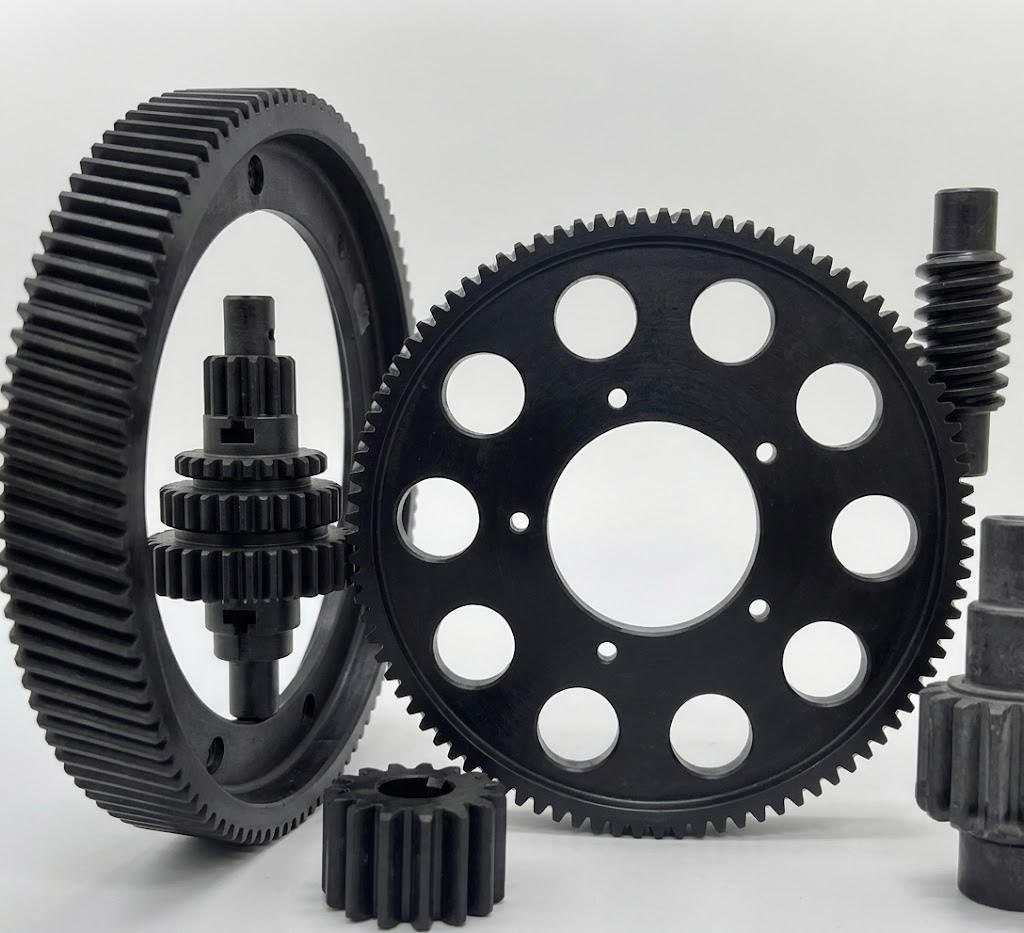
Surface Finishing and Secondary Operations
Machining alone may not deliver the final appearance or surface performance your application requires. VOK lists a range of finishing and secondary operations for metal and plastic components.
Available options include:
- Metal finishing: Anodizing, black oxide, nickel plating, chrome plating, chromate treatment, and PVD coating.
- Paint and appearance: Glossy or matte painting, aluminum spraying, mirror polishing, and brushed finishes.
- Assembly and fabrication: Aluminum riveting, steel welding, and brass inserts.
- Plastic finishing: High polishing for PMMA, ABS finishing, clear PC processing, and anti-UV coating.
Specify the required finish, color, surface quality, and functional requirements on your technical drawings. This helps the manufacturing team assess feasibility before production begins.
CNC Machining vs. Other Manufacturing Processes
CNC machining is not the right choice for every component. Comparing production methods helps you select a process that balances accuracy, tooling investment, material requirements, and production volume.
| Manufacturing method | Best suited for | Key consideration |
|---|---|---|
| CNC machining | Precision prototypes and functional metal or plastic parts | Material is removed from solid stock |
| 3D printing | Complex geometries and early design validation | Material properties and surface finish depend on the process |
| Vacuum casting | Small batches of parts with casting-like characteristics | Silicone molds have a limited service life |
| Injection molding | Repeated production of plastic parts at scale | Mold investment and design preparation affect initial cost |
| Sheet metal fabrication | Enclosures, brackets, and formed metal structures | Depends on sheet thickness, bending, and joining requirements |
VOK also offers 3D printing, vacuum casting, sheet metal fabrication, rapid tooling, and injection molding. This broader manufacturing range allows you to compare suitable processes instead of selecting CNC machining by default.
How to Order Custom CNC Machined Parts
A structured quotation process helps reduce misunderstandings and speeds up project evaluation.
- Prepare your design files. Provide a 2D engineering drawing and a 3D CAD file when available. Include dimensions, tolerances, material specifications, and critical features.
- Define your requirements. State the required quantity, intended application, surface finish, inspection criteria, and delivery destination.
- Review manufacturing feasibility. Ask VOK to evaluate tool access, wall thickness, material suitability, tolerances, and potential design improvements.
- Confirm the quotation. Review pricing, production lead time, finishing costs, and any additional inspection requirements before approving the order.
- Validate the parts. Inspect the delivered components against your drawings and functional requirements before moving into the next production stage.
Providing complete specifications at the beginning helps your supplier identify risks earlier and prepare a more relevant quotation.
Frequently Asked Questions
1. What files do I need to request a CNC machining quote?
A 3D CAD model, such as STEP, together with a dimensioned 2D drawing is a useful starting point. Include material, quantity, tolerances, surface finish, and any critical inspection requirements.
2. Can VOK manufacture both prototypes and production parts?
Yes. VOK describes its services as covering early-stage prototyping through full-scale production. Confirm your required quantity, production schedule, and quality criteria with the team before starting the project.
3. How do I choose between CNC machining and injection molding?
CNC machining is often suitable for functional prototypes, metal parts, and projects that need design flexibility without a dedicated mold. Injection molding may become more economical for repeated plastic part production at higher volumes, depending on part complexity, tooling cost, and unit price.
Conclusion
Choosing the right CNC machining factory means evaluating machining capabilities, material options, dimensional requirements, finishing services, and communication throughout the manufacturing process. VOK PRECISION TECHNOLOGY Co., LTD combines CNC milling and turning with four-axis and five-axis machining, metal and plastic processing, and a broader range of prototyping and production services. By sharing complete drawings and clearly defined requirements, you can assess manufacturing feasibility, compare process options, and move your custom parts project toward production with greater confidence.