When your product design requires realistic prototypes but injection molding is too expensive for early-stage development, Urethane Casting provides an efficient solution. This manufacturing process helps you create highly detailed prototypes and small-scale production parts with excellent surface quality, dimensional accuracy, and material flexibility.
For engineers, product designers, and manufacturers, Urethane Casting reduces tooling investment while supporting faster product validation. VOK provides custom vacuum casting solutions using silicone molds, professional production experience, and strict quality control to help you move from concept validation to functional prototypes efficiently.
What Is Urethane Casting and How Does Vacuum Casting Work?
Urethane Casting, also known as vacuum casting, is a manufacturing process that uses silicone molds to produce polyurethane prototype parts. It is commonly used for rapid prototyping, functional testing, product development, and low-volume manufacturing.
Unlike traditional injection molding, vacuum casting does not require expensive steel tooling. Instead, silicone molds can be produced quickly from a master model, making this process suitable for startups, R&D teams, and companies needing flexible production.
Typical applications include:
- Consumer electronics prototypes
- Automotive interior and exterior components
- Medical device prototypes
- Industrial equipment housings
- Custom functional testing parts
VOK uses advanced prototyping technologies, including CNC machining and 3D printing, to create accurate master models before the casting process begins.
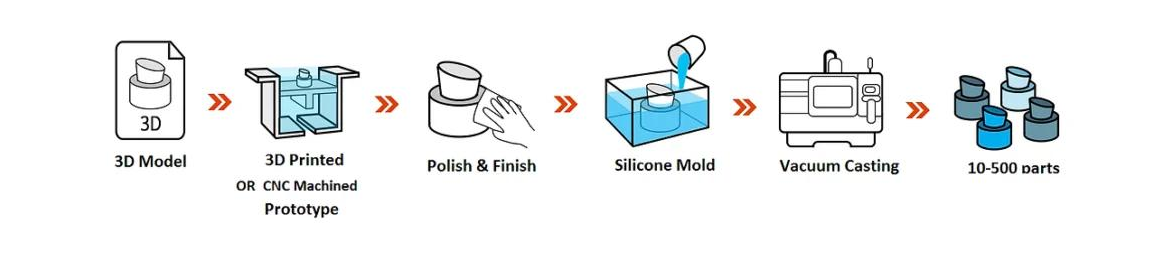
How to Build Vacuum Casting Parts?
The vacuum casting process includes several controlled manufacturing steps:
Step 1: Master Model Creation
You first need a precise master model created through:
- CNC machining
- SLA or other 3D printing technologies
- Precision surface finishing
The quality of the master model directly affects the final casting accuracy and surface appearance.
Step 2: Silicone Mold Preparation
After the master model is completed, VOK creates a silicone mold around the model.
This stage focuses on:
- Mold structure design
- Air channel optimization
- Parting line planning
- Mold durability improvement
Silicone molds provide a cost-effective tooling option compared with traditional injection molds.
Step 3: Vacuum Casting Process
During casting, liquid polyurethane resin is mixed and poured into the silicone mold under vacuum conditions.
The vacuum environment helps:
- Remove trapped air bubbles
- Improve material distribution
- Maintain consistent part quality
- Achieve detailed surface reproduction
Temperature and curing time are carefully controlled to ensure stable mechanical performance.
Step 4: Final Processing and Inspection
After curing, the cast part is removed from the mold and undergoes finishing processes, including:
- Surface polishing
- Painting
- Assembly
- Dimensional inspection
VOK maintains quality control procedures to ensure prototype parts meet customer specifications.
Key Advantages of Vacuum Casting Service
Choosing a professional vacuum casting service helps you achieve reliable prototypes without large upfront tooling costs.
| Feature | Vacuum Casting | Injection Molding |
|---|---|---|
| Tooling Cost | Lower silicone mold investment | Higher steel mold cost |
| Production Volume | Ideal for low-volume production | Suitable for mass production |
| Lead Time | Silicone molds created within days | Longer tooling preparation |
| Material Options | ABS, PC, POM, PP, rubber, silicone | Limited by mold design |
| Prototype Validation | Excellent for functional testing | Better for final production |
Key benefits include:
Precision Manufacturing
VOK vacuum casting achieves dimensional accuracy of approximately 100mm/±0.20mm, helping engineers validate product designs before mass production.
Low-Cost Tooling
Silicone molds require less investment compared with injection molds. This makes vacuum casting suitable for:
- Product testing
- Market evaluation
- Small batch production
- Engineering verification
Material Versatility
You can select materials with different properties, including:
- ABS-like polyurethane
- PC-like resin
- Rubber-like materials
- Silicone materials
- Flexible elastomers
These options allow prototypes to simulate the performance of final products.
Fast Turnaround
Because silicone molds can be produced quickly, vacuum casting supports rapid product development cycles and helps reduce time from design to testing.
Vacuum Casting Overmold Solutions
Vacuum Casting Overmold is an advanced process that combines two or more materials or components into one finished part.
VOK provides customized overmolding solutions, including:
- Rigid plastic and rubber overmold
- Metal and rigid plastic overmold
- Metal and rubber plastic overmold
- Insert overmolding
This technology is useful when you need products with:
- Soft-touch surfaces
- Enhanced grip performance
- Multiple material functions
- Integrated metal components
For example, automotive components, electronic housings, and industrial handles often use overmolding to improve product performance and user experience.
Why Choose VOK for Urethane Casting?
VOK focuses on providing complete rapid manufacturing solutions from prototype development to low-volume production.
With professional engineering support, VOK helps customers achieve reliable results through:
- Experienced prototype manufacturing processes
- CNC machining and 3D printing capabilities
- Strict quality inspection procedures
- Custom material selection
- Flexible production quantities
VOK supports global customers with prototype development requirements and provides manufacturing solutions for industries such as automotive, electronics, medical equipment, and industrial products.
FAQ
1. How many parts can a silicone mold produce?
A silicone mold can typically produce multiple prototype parts depending on the material, part design, and production requirements. It is commonly used for small-batch production.
2. What materials can be used for urethane casting?
Common materials include ABS-like resin, PC-like resin, POM-like materials, polypropylene-like materials, rubber materials, and silicone.
3. Is vacuum casting suitable for mass production?
Vacuum casting is mainly designed for prototypes and low-volume production. For high-volume manufacturing, injection molding may become more economical.
Conclusion
When you need accurate prototypes, flexible materials, and cost-effective small-batch production, Urethane Casting offers a practical manufacturing solution. By combining silicone mold technology, precise production control, and rapid turnaround, VOK helps you transform product concepts into functional prototype parts efficiently.
From product validation to vacuum casting service requirements, VOK provides customized manufacturing support for engineers, designers, and businesses looking for reliable prototype solutions.
Get Your Custom Vacuum Casting Quote from VOK
Send your 3D drawings or prototype requirements to VOK today. Our engineering team can evaluate your project, recommend suitable materials, and provide a customized Urethane Casting solution for your product development needs.